
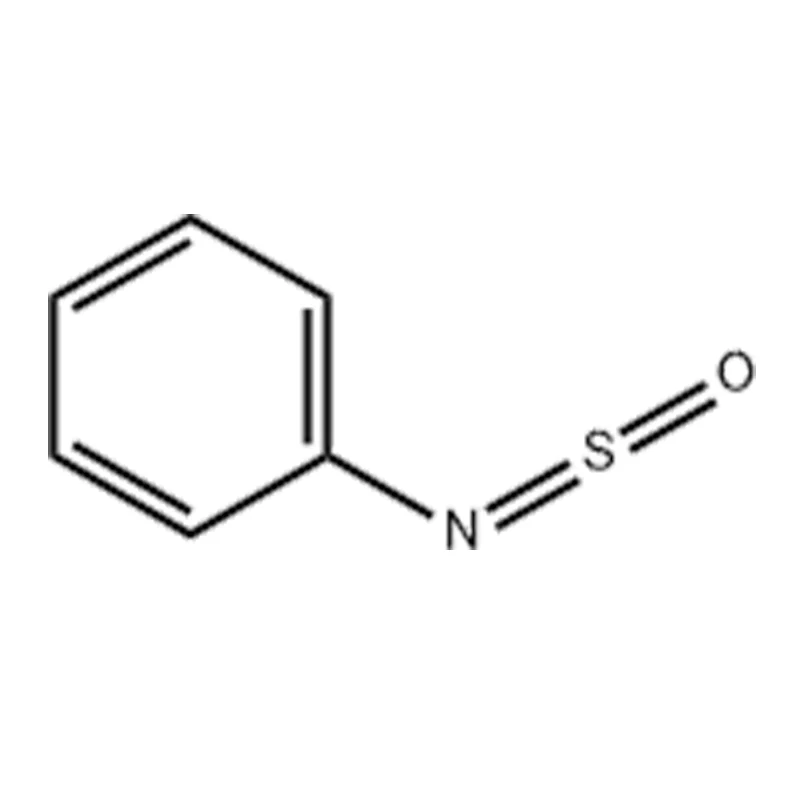
N-Thionylaniline (CAS 1122-83-4), also referred to as N-sulfinylaniline, is an organosulfur compound with the molecular formula C₆H₅NOS and a molecular weight of 139.18 g/mol. It appears as a light yellow to orange clear liquid, sometimes described as a straw‑colored or very strongly colored liquid, with a density of 1.236 g/mL at 25 °C, a boiling point of 200 °C at standard pressure (or 83 °C at 15 mmHg), and a flash point of 84 °C.
In organic synthesis, N-thionylaniline is a highly valued reagent and building block. Its sulfinyl group can act as both an electrophile and a nucleophile, facilitating a wide range of chemical transformations. As a source of the N‑sulfinyl group, N-thionylaniline enables the introduction of sulfur-containing fragments into organic molecules through nucleophilic aromatic substitution, where it acts as a source of a reactive sulfur‑containing anionic species. This capability makes N-thionylaniline a versatile synthetic intermediate for preparing sulfur-containing organic compounds, including biologically active intermediates, agrochemicals, and functional materials.
In materials science and medicinal chemistry, N-thionylaniline has been employed in the synthesis of novel low‑band‑gap donor–acceptor copolymers for organic electronics and as a precursor for fluorescent probes used in cancer imaging, showing applications ranging from materials science to pharmaceutical development. The compound also serves as a dienophile in Diels‑Alder cycloaddition reactions, a reactivity that has been exploited to generate 1,2-thiazine derivatives and other heterocyclic scaffolds. Additionally, N-thionylaniline participates in organometallic ligand‑exchange reactions and has been used in the synthesis of narrow‑bandgap polymers.
|
Parameter |
Specification |
|
CAS Number |
1122-83-4 |
|
MDL Number |
MFCD00002084 |
|
EINECS Number |
214-362-4 |
|
Molecular Formula |
C₆H₅NOS |
|
Molecular Weight |
139.18 g/mol |
|
Purity |
≥98.0% (GC) as standard |
|
Appearance |
Light yellow to orange clear liquid; straw-colored or very strongly colored liquid |
|
Density |
1.236 g/mL at 25 °C |
|
Boiling Point |
200 °C at 760 mmHg; 83 °C at 15 mmHg |
|
Flash Point |
84 °C (closed cup) |
|
Refractive Index |
n20/D 1.627 |
|
Solubility |
Partly miscible in water |
|
Canonical SMILES |
O=S=NC1=CC=CC=C1 |
|
Storage Condition |
Store under inert gas (nitrogen or argon), refrigerated at 2–8°C, in a cool dry place away from light and heat |
|
DOT/IATA Transport |
UN 1993, Combustible Liquid, Packing Group III |
|
Hazard Class |
Flammable liquid (Class 3) |
|
GHS Signal Word |
Danger |
|
Hazard Statements |
H315 (skin irritation), H319 (serious eye irritation), H334 (may cause allergy or asthma symptoms), H335 (may cause respiratory irritation) |
|
Storage Class |
3 – flammable liquid |
● Causes skin irritation
● Causes serious eye irritation
● May cause allergy or asthma symptoms or breathing difficulties if inhaled
● May cause respiratory irritation
● Combustible liquid
● Avoid breathing dust/fume/gas/mist/vapours/spray
● Wash thoroughly after handling
● Use only outdoors or in a well‑ventilated area
● Wear protective gloves/protective clothing/eye protection/face protection
● In case of inadequate ventilation, wear respiratory protection
● IF ON SKIN: Wash with plenty of water
● IF INHALED: Remove person to fresh air and keep comfortable for breathing
● IF IN EYES: Rinse cautiously with water for several minutes. Remove contact lenses if present and easy to do. Continue rinsing
● IF EXPERIENCING RESPIRATORY SYMPTOMS: Call a POISON CENTER/doctor
● Store in a well‑ventilated place. Keep container tightly closed
● Store locked up
● Dispose of contents/container in accordance with local regulations
● If inhaled: Move person into fresh air. If not breathing, give artificial respiration. Consult a physician.
● In case of skin contact: Wash off with soap and plenty of water. Consult a physician if skin irritation persists.
● In case of eye contact: Rinse thoroughly with plenty of water for at least 15 minutes and consult a physician. Continue rinsing during transport to hospital.
● If swallowed: Rinse mouth with water. Never give anything by mouth to an unconscious person. Consult a physician.
A: Yes. N-Thionylaniline is classified as a dangerous good (UN 1993, Combustible Liquid, Packing Group III). It has GHS signal word “Danger” with hazard statements H315 (skin irritation), H319 (serious eye irritation), H334 (may cause allergy or asthma symptoms or breathing difficulties if inhaled), and H335 (may cause respiratory irritation).
A: Yes. With our large‑scale reactors (20 L–5000 L), we support production from gram‑scale R&D samples to multi‑kilogram commercial batches. Please contact us for a custom quote.
We look forward to supporting your research and production needs.If you have any questions regarding N-Thionylaniline (CAS 1122-83-4) or wish to request a quotation, please do not hesitate to reach out. Our sales and technical support teams are ready to assist you.
Address
No. 2 Yangguang 3rd Road, Duodao Chemical Cycle Industrial Park, Jingmen City, Hubei Province, China
Tel

![1-[2,3-Bis[(9Z,12Z)-octadeca-9,12-dien-1-yloxy]propyl]pyrrolidine](https://www.cosperpharma.com/upload/8820/1-2-3-bis-9z-12z-octadeca-9-12-dien-1-yloxy-propyl-pyrrolidine-349384.webp "1-[2,3-Bis[(9Z,12Z)-octadeca-9,12-dien-1-yloxy]propyl]pyrrolidine")
![1,2,4-Triazolo[4,3-a]pyridin-3(2H)-one](https://www.cosperpharma.com/upload/8820/1-2-4-triazolo-4-3-a-pyridin-3-2h-one-440735.webp "1,2,4-Triazolo[4,3-a]pyridin-3(2H)-one")