
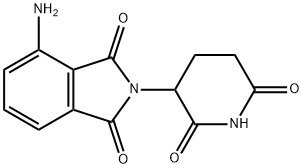
Pomalidomide (CAS 19171-19-8) is a potent immunomodulatory agent and third‑generation thalidomide analog. The molecule features an isoindoline‑1,3‑dione core with an amino group at the 4‑position and a 2,6‑dioxopiperidin‑3‑yl substituent at the 2‑position. This unique structural architecture enables Pomalidomide to bind cereblon (CRBN), a component of the cullin‑RING E3 ubiquitin ligase complex, with high affinity.
Pomalidomide is a potent immunomodulatory agent that inhibits TNF‑α with an IC₅₀ of 13 nM in PBMCs and potently inhibits IL‑2 with an EC₅₀ of 8 nM. As a thalidomide derivative, Pomalidomide binds cereblon and inhibits its ubiquitination, thereby modulating the activity of the E3 ubiquitin ligase complex. The compound enhances T cell‑ and natural killer (NK) cell‑mediated immunity and inhibits production of pro‑inflammatory cytokines by monocytes. Pomalidomide also demonstrates synergistic antiproliferative activity in combination regimens and is primarily utilized in the treatment of multiple myeloma. As a high‑purity reference standard, Pomalidomide is indispensable for analytical method development, impurity profiling, quality control testing, and ANDA filings for generic pomalidomide manufacturers. Additionally, Pomalidomide serves as a critical tool compound for studying immunomodulation, cereblon biology, and targeted protein degradation via PROTAC technology.
Product Parameters
Parameter
Specification
Product Name
Pomalidomide
CAS Number
19171-19-8
Molecular Formula
C₁₃H₁₁N₃O₄
Molecular Weight
273.24 g/mol
Appearance
Yellow powder
Melting Point
318.5320.5°C
Boiling Point
582.9±45.0°C (Predicted)
Density
1.570±0.06 g/cm³ (Predicted)
pKa
10.75±0.40 (Predicted)
Solubility
DMSO: ≥14 mg/mL
Storage Condition
28°C
Application
Pomalidomide, with the chemical name 4-amino-2-(2,6-dioxo-piperidin-3-yl)-iso-dihydroindole-1,3-dione, is a thalidomide analogue and an immunomodulator with antitumor activity. In vitro cytological studies demonstrate its ability to inhibit the proliferation of hematopoietic tumor cells and induce apoptosis. Additionally, pomalidomide suppresses the proliferation of lenalidomide-resistant multiple myeloma cell lines and synergistically induces tumor cell apoptosis in both lenalidomide-sensitive and lenalidomide-resistant cell lines when combined with dexamethasone.
Synthetic Route
Using 3-nitrophthalic anhydride as the starting material, it is reacted with 3-amino-2,6-piperidinedione to yield the intermediate product, which is then reduced with Pd/C in a hydrogen atmosphere to obtain the target compound pomaludamide. Although this reaction route involves few steps, 3-nitrophthalic anhydride is an unstable raw material prone to hydrolysis and degradation during transportation or storage, compromising raw material quality. Additionally, the reaction operates in an intermittent system with low continuity, while hydrogen represents a hazardous gas, resulting in suboptimal safety conditions in the production environment.
Storage and Transportation
Pomalidomide must be stored in a tightly sealed container, in a cool, dry place, and protected from light: for long-term storage, maintain at 2–8°C; for short-term storage, store at room temperature (20–25°C). Avoid high temperatures, light exposure, and humidity to prevent degradation. Transportation shall comply with regulations for high-risk teratogenic prescription drugs, using aluminum foil bags/citrulline vials for sealed packaging with external foam cushioning. Transport at room temperature away from light; avoid direct sunlight and vigorous shaking. Store away from strong oxidizers, acids, and alkalis; do not transport with food or feed. Maintain strict leak prevention measures and provide clear warnings regarding teratogenic risks throughout transportation.
Contact Us
Trust Cosperpharm for Pomalidomide that meets the highest standards of purity and documentation — reach out to discuss your requirements.
Hot Tags: Pomalidomide, China, Manufacturer, Supplier, Factory
We use cookies to offer you a better browsing experience, analyze site traffic and personalize content. By using this site, you agree to our use of cookies.Privacy Policy