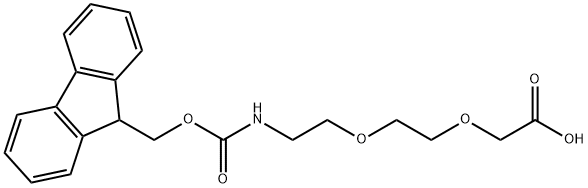
Fmoc-Ado-OH (Fmoc-8-amino-3,6-dioxaoctanoic acid, also known as Fmoc-AEEA or Fmoc-NH-PEG₂-CH₂COOH) is an Fmoc-protected amino-PEG₂-acetic acid derivative featuring a flexible polyethylene glycol (PEG) spacer between the Fmoc-protected amine and the terminal carboxylic acid. The molecule consists of an Fmoc-protected primary amine linked to a carboxylic acid through a 3,6-dioxaoctanoic acid spacer—a hydrophilic PEG₂ chain that imparts water solubility and conformational flexibility.
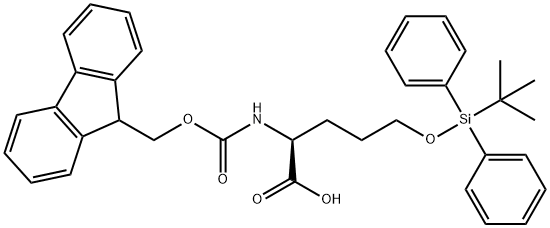
Fmoc-5-Hydroxy-Nva(TBDPS)-OH (N-fluorenylmethoxycarbonyl-5-(tert-butyldiphenylsilyl)oxy-L-norvaline) is a specialized Fmoc-protected, non-proteinogenic amino acid derivative featuring a hydroxy modification at the side chain of norvaline. The molecule incorporates the acid-labile 9-fluorenylmethyloxycarbonyl (Fmoc) group protecting the N-terminus, while the side-chain hydroxyl group is masked by the tert-butyldiphenylsilyl (TBDPS) protecting group—a bulky, acid-stable silyl ether that provides orthogonal protection during peptide synthesis.
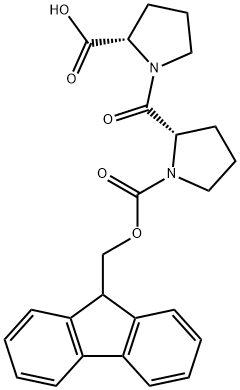
Fmoc-Pro-Pro-OH (N-fluorenylmethoxycarbonyl-L-prolyl-L-proline) is an Fmoc-protected dipeptide composed of two L-proline residues linked through a peptide bond. The molecule features the acid-labile 9-fluorenylmethyloxycarbonyl (Fmoc) group protecting the N-terminus, while the C-terminal carboxylic acid remains free for coupling reactions. The presence of two consecutive proline residues imparts significant conformational rigidity to the peptide backbone due to proline‘s unique cyclic pyrrolidine ring structure, which restricts backbone flexibility and promotes the formation of turn and helical secondary structures.
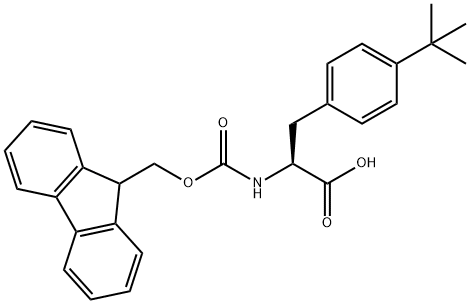
Fmoc-Phe(4-tBu)-OH (Fmoc-4-tert-butyl-L-phenylalanine, CAS 213383-02-9) is a fluorenylmethyloxycarbonyl (Fmoc)-protected aromatic amino acid derivative employed as a building block in solid-phase peptide synthesis. The molecule features a 9-fluorenylmethyloxycarbonyl (Fmoc) group protecting the α-amino functionality and a bulky 4-tert-butyl substituent on the phenyl ring of the phenylalanine side chain.
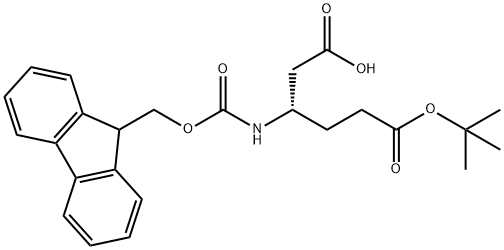
Fmoc-beta-HGlu(OtBu)-OH (Fmoc-L-β-homoglutamic acid 6-tert-butyl ester, CAS 203854-49-3) is a specialized β-amino acid derivative designed for Fmoc/t-Bu solid-phase peptide synthesis. The molecule features a 9-fluorenylmethyloxycarbonyl (Fmoc) protecting group on the amino function and a tert-butyl ester protecting the side-chain carboxyl function at the 6-position. The β-homoglutamic acid backbone extends the peptide chain by one carbon atom compared to standard glutamic acid, providing unique conformational and functional properties.
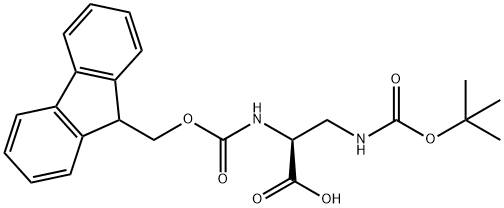
Fmoc-Dap(Boc)-OH (Nα-Fmoc-Nβ-Boc-L-2,3-diaminopropionic acid, CAS 162558-25-0) is an orthogonally protected, chiral non-proteinogenic amino acid derivative classified as an L-2,3-diaminopropionic acid (Dap) building block. The molecule features an acid-labile tert-butoxycarbonyl (Boc) protecting group on the side-chain β-amino functionality and a base-labile 9-fluorenylmethyloxycarbonyl (Fmoc) group on the α-amino position.
We use cookies to offer you a better browsing experience, analyze site traffic and personalize content. By using this site, you agree to our use of cookies. Privacy Policy