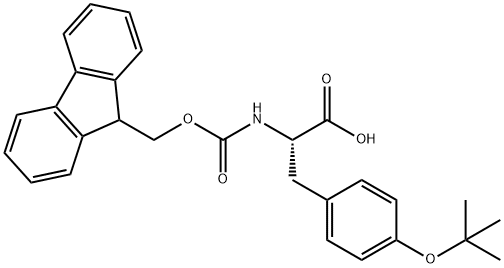
Fmoc-Tyr(tBu)-OH (Nα-[(9H-fluoren-9-ylmethoxy)carbonyl]-O-tert-butyl-L-tyrosine) is a Fmoc-protected tyrosine derivative featuring a tert-butyl (tBu) ether protecting group on the phenolic hydroxyl side chain. The tyrosine side chain — a phenol ring with a free hydroxyl group — is susceptible to unwanted side reactions during peptide synthesis, including acylation, oxidation, and formation of O-acylated byproducts.
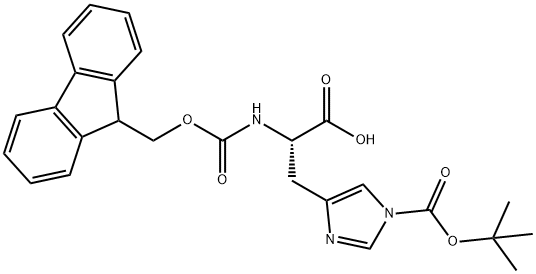
Fmoc-His(Boc)-OH (Nα-[(9H-fluoren-9-ylmethoxy)carbonyl]-Nτ-tert-butoxycarbonyl-L-histidine) is a doubly protected histidine derivative featuring the base-labile Fmoc (9-fluorenylmethoxycarbonyl) group at the α-amino position and the acid-labile Boc (tert-butoxycarbonyl) group on the imidazole side-chain Nτ nitrogen. This orthogonal protection strategy — Fmoc removable under mild basic conditions and Boc cleaved under acidic conditions — enables precise, sequential deprotection during solid-phase peptide synthesis (SPPS).
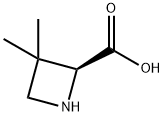
2-Azetidinecarboxylic acid, 3,3-dimethyl-, (2S)- (CAS 1860033-50-6), also known as (S)-3,3-dimethylazetidine-2-carboxylic acid, is a chiral, non-proteinogenic α-amino acid built upon a strained four-membered azetidine ring. The molecule features a secondary amine within the ring, a carboxylic acid group at the 2-position, and two methyl groups at the 3-position that introduce significant steric hindrance. This unique combination of ring strain and steric bulk creates a highly rigid, conformationally constrained scaffold that is fundamentally different from natural amino acids. First synthesized as a target by De Kimpe, Boeykens, and Tourwé in 1998, this compound has since become a valuable tool in peptide chemistry, where its ability to restrict backbone flexibility makes it a powerful building block for designing peptides with enhanced target binding affinity and metabolic stability.
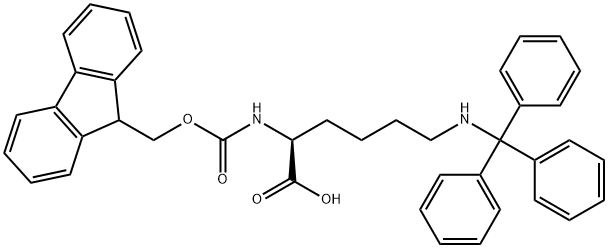
Fmoc-Lys(Trt)-OH (Nα-Fmoc-Nε-trityl-L-lysine, CAS 111061-54-2) is an orthogonally protected derivative of the essential amino acid L-lysine. The molecule features a 9-fluorenylmethyloxycarbonyl (Fmoc) group protecting the α-amino functionality and a trityl (Trt) group protecting the ε-amino side chain.
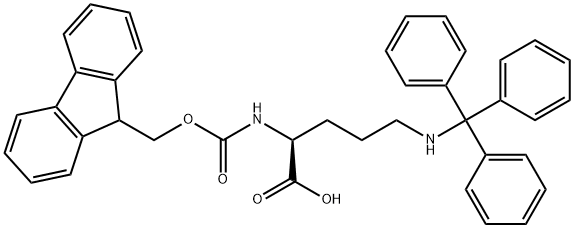
Fmoc-Orn(Trt)-OH (Nα-Fmoc-Nδ-trityl-L-ornithine, CAS 1998701-26-0) is an orthogonally protected derivative of the naturally occurring non-proteinogenic amino acid L-ornithine. The molecule features a 9-fluorenylmethyloxycarbonyl (Fmoc) group protecting the α-amino functionality and a trityl (Trt) group protecting the δ-amino side chain.
Benzo[1,2-b:4,5-b']difuran-2,6(3H,7H)-dione (also known as 3,7-dihydrobenzo[1,2-b:4,5-b']difuran-2,6-dione) is a fused heterocyclic compound featuring a central benzene ring flanked by two dihydrofuran-2-one rings. The molecule adopts a rigid, planar, ladder-type architecture with the molecular formula C₁₀H₆O₄ and a molecular weight of 190.15 g/mol. This π-extended fused ring system creates an extensively conjugated framework with two lactone carbonyl groups positioned symmetrically at the 2- and 6-positions.
We use cookies to offer you a better browsing experience, analyze site traffic and personalize content. By using this site, you agree to our use of cookies. Privacy Policy


![benzo[1,2-b:4,5-b']difuran-2,6(3H,7H)-dione](https://www.cosperpharma.com/upload/8820/benzo-1-2-b-4-5-b-difuran-2-6-3h-7h-dione-204233.png "benzo[1,2-b:4,5-b']difuran-2,6(3H,7H)-dione")