
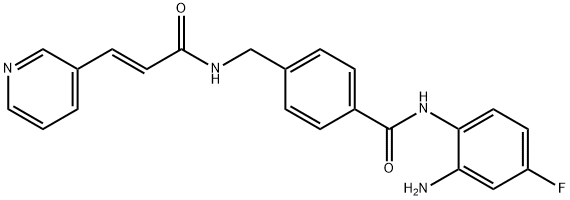
Tucidinostat is a clinically approved HDAC inhibitor developed for the treatment of peripheral T-cell lymphoma and other hematological malignancies . The therapeutic mechanism of Tucidinostat involves selective inhibition of class I HDAC enzymes (HDAC1, HDAC2, HDAC3) and class IIb HDAC10, with IC₅₀ values of 95 nM, 160 nM, 67 nM, and 78 nM, respectively . By inhibiting these enzymes, Tucidinostat promotes histone hyperacetylation, leading to chromatin relaxation and transcriptional activation of tumor suppressor genes and other key regulatory pathways. Beyond oncology, Tucidinostat has demonstrated significant potential in HIV latency research, where it has been shown to reactivate latent HIV provirus, offering a promising strategy for eliminating the HIV reservoir . This dual clinical and research utility of Tucidinostat positions it as a versatile epigenetic tool compound with broad applications in drug discovery and molecular biology.
|
Parameter |
Specification |
|
Product Name |
Tucidinostat |
|
CAS Number |
|
|
Molecular Formula |
|
|
Molecular Weight |
|
|
Appearance |
|
|
Storage Condition |
Powder: –20°C (3 years); Solution: –20°C (6 months) |
Tucidinostat (Chidamide, HBI-8000, CS-055) is a low-molarity inhibitor of HDAC1, 2, 3, and 10, with IC50 values of 95, 160, 67, and 78 nM, respectively.
Chidamide inhibits class I HDACs 1-3 and class IIb HDAC10. In human cervical adenocarcinoma HeLa cells and human PBMC cells, Chidamide significantly induces histone H3 acetylation. In the micromolar concentration range, Chidamide and MS-275 can inhibit the cell growth of most human tumor cell lines, but not all tested tumor cells (a total of 18 types were tested). In human embryonic kidney (CCC-HEK) and human embryonic liver (CCC-HEL) cells, the toxic effect of Chidamide on normal cells is greatly reduced compared with MS-275, indicating the difference in the cytotoxic effects of Chidamide on normal cells and cancer cells.
In a mouse colon cancer HCT-8 xenograft model, Chidamide exhibits in vivo anti-tumor activity. Chidamide administered at a concentration range of 12.5-50 mg/kg reduces tumor size and weight in a concentration-dependent manner. When administered at 50 mg/kg, Chidamide has similar or even greater efficacy compared to the control drug groups 5-FU (20 mg/kg) and MS-275 (25 mg/kg). In tumor-bearing animal models, Chidamide is well tolerated.
Ready to source Tucidinostat for your epigenetic research or oncology program? Cosperpharm is your trusted partner for high-quality HDAC inhibitors. Contact us today to discuss your requirements and request a quote.
Address
No. 2 Yangguang 3rd Road, Duodao Chemical Cycle Industrial Park, Jingmen City, Hubei Province, China
Tel