
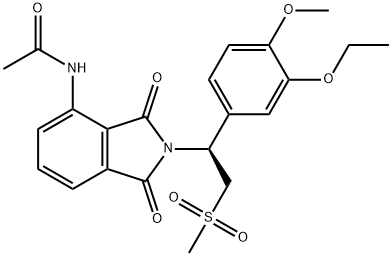
Apremilast is a pivotal pharmaceutical intermediate and certified reference standard in the industrial synthesis and quality control of this first-in-class oral PDE4 inhibitor. The phthalimide core of Apremilast is synthesized through an acid-catalyzed condensation reaction between 3-acetamidophthalic anhydride and (S)-1-(3-ethoxy-4-methoxyphenyl)-2-(methylsulfonyl)ethan-1-amine. In quality control contexts, Apremilast and its related impurities—including Apremilast EP Impurity D, Impurity A, Impurity B, and various process-related byproducts—are essential analytical reference standards for impurity profiling, analytical method development, forced degradation studies, and quality control testing for generic manufacturers. As an orally active PDE4 inhibitor that modulates both innate and adaptive immune responses, Apremilast represents a significant therapeutic advance for inflammatory conditions. The phthalimide scaffold of Apremilast serves as a versatile platform for PDE4 inhibitor development, making Apremilast indispensable for pharmaceutical manufacturers developing generic versions and for analytical laboratories performing quality control testing.
Product Parameters
|
Parameter |
Specification |
|
Product Name |
Apremilast |
|
CAS Number |
608141-41-9 |
|
Molecular Formula |
C₂₂H₂₄N₂O₇S |
|
Molecular Weight |
460.5 g/mol |
|
Appearance |
White to light yellow solid |
|
Density |
1.381 g/cm³ |
|
Boiling Point |
741.3±60.0 °C at 760 mmHg |
|
Melting Point |
152-156 ℃ |
|
Storage Condition |
Refrigerator |
Preclinical Study
The study first transplanted normal human skin onto mice with severe combined immunodeficiency (SCID) and, after four weeks of transplantation, stimulated the skin using natural killer (NK) cells from psoriasis patients. Two weeks after NK cell injection, the mice were divided into three groups of seven each and administered either apustat or a placebo of cyclosporine orally. The rates of partial or complete histological recovery in the apustat group and the cyclosporine group were 57.1% and 42.9%, respectively. The results demonstrated that this drug effectively reduced epidermal thickness while significantly lowering concentrations of inflammation-related biomarkers such as TNF-α, intercellular adhesion molecule-1 (ICAM-1), and human leukocyte antigen DR (HLA-DR), with superior efficacy compared to the cyclosporine group.
2. Pharmacokinetics
The patient was administered apustat 20 mg/day, and pharmacokinetic parameters were monitored over 29 days. The half-life (t1/2) was 8.2 hours, the area under the concentration-time curve (AUC) was 1.799 μg/mL, the peak plasma concentration time (tmax) was 2 hours, the bioavailability was 10.4 L/h, the volume of distribution was 128 L, and the average steady-state plasma maximum concentration (Cmax) was 0.207 μg/mL (0.450 μmol/L). At this concentration, apustat effectively inhibited approximately 70% of THF-α production induced by lipopolysaccharide (LPS) in peripheral blood mononuclear cells (PBMCs).
Mechanism Of Action
Drug Interaction
2. In vitro, although apustat is a substrate of P-glycoprotein (P-gp), its bioavailability in vivo exceeds 70%, and no significant interactions have been observed with ketoconazole (as studied in the DDI research involving CYP3A and P-gp inhibitors). Therefore, it does not inhibit systemic concentrations of P-gp.
3. No significant pharmacokinetic interactions have been observed when Apust (30 mg, qd, po) is co-administered with oral contraceptives, ketoconazole, or methotrexate.
4. Concomitant administration of the CYP450 inducer rifampin (600 mg, once daily, orally, for 15 days) with Aprest (30 mg, once daily, orally) resulted in a 72% reduction in Aprest's AUC and a 43% decrease in its Cmax.
Contact Us
Address
No. 2 Yangguang 3rd Road, Duodao Chemical Cycle Industrial Park, Jingmen City, Hubei Province, China
Tel