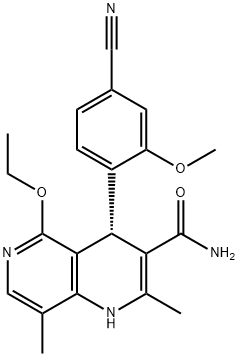
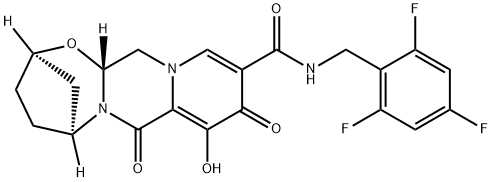
Bictegravir is a pivotal active pharmaceutical ingredient (API) in the treatment of HIV-1 infection, serving as the integrase strand transfer inhibitor component of the single-tablet regimen Biktarvy®. As a potent and selective inhibitor of HIV-1 integrase, Bictegravir demonstrates an IC₅₀ of 7.5 nM for strand transfer activity and exhibits potent antiviral effects in primary CD4⁺ T lymphocytes with an EC₅₀ of 1.5 ± 0.3 nM. Bictegravir maintains efficacy against clinical isolates of HIV-1 with EC₅₀ values ranging from 0.04 to 1.7 nM in human peripheral blood mononuclear cells. The compound's long dissociative half-life from the integrase-DNA complex contributes to its high resistance barrier—Bictegravir shows only a 2.1-fold EC₅₀ increase against the G140S+Q148H mutant compared to 4.3-fold for dolutegravir and over 100-fold for raltegravir and elvitegravir. Beyond its therapeutic application, Bictegravir serves as a reference standard for analytical method development, impurity profiling, and quality control testing in the manufacture of HIV antiretroviral therapies.
Product Parameters
|
Parameter |
Specification |
|
Product Name |
Bictegravir |
|
CAS Number |
|
|
Molecular Formula |
|
|
Molecular Weight |
|
|
Physical Form |
|
|
Appearance |
|
|
Melting Point |
|
|
Boiling Point |
|
|
Density |
1.62 ± 0.1 g/cm³ (Predicted) |
|
Storage Condition |
Sealed in dry,Store in freezer, under -20°C |
Application
Synthetic Route
Step 2: Mix crude 1-(2,2-dihydroxyethyl)-5-methoxy-6-(methoxycarbonyl)-4-oxo-1,4-dihydropyridin-3-carboxylic acid (16.8 mL from the crude mixture of Step 1, approximately 4 mmol) with (1S,3R)-3-amino cyclopentanol (0.809 g, 8 mmol), dilute with acetonitrile (16.8 mL), and treat with potassium carbonate (0.553 g, 4 mmol). Heat the reaction mixture to 85 °C, stir for 15 minutes, cool to room temperature, and continue stirring for 16 hours. Add HCl (50 mL, 0.2 M) and extract the clear yellow solution three times with dichloromethane. Dry the combined organic layers with sodium sulfate, filter, and concentrate to obtain a yellow solid. Precipitate the crude product from dichloromethane/hexane to yield the desired intermediate 15-B as a light beige powder.
Step 3: Dissolve compound 15-B (38 mg, 0.12 mmol) in 1 mL of acetonitrile, add 2,4,6-trifluorobenzylamine (34 mg, 0.21 mmol), HATU (50 mg, 0.13 mmol), and N,N-diisopropylethylamine (DIPEA) (23 mg, 0.18 mmol), and stir at room temperature for 2 hours. LC-MS analysis subsequently confirmed complete consumption of compound 15-B and formation of intermediate 45-A. Proceed to the next step with the reaction mixture.
Step 4: Add MgBr₂ (55 mg, 0.30 mmol) to the crude reaction mixture obtained from the previous step. Stir the reaction mixture at 50 °C for 1 hour, acidify it with a 10% HCl aqueous solution, separate the phases into an aqueous phase and a dichloromethane phase, and extract the aqueous phase with dichloromethane. The combined organic phases are dried with MgSO₄, filtered, concentrated, and purified by HPLC using ACN/H₂O containing 0.1% TFA as the mobile phase, yielding compound 45, brigetiravir.
Pharmacological Action
New Anti-AIDS Drugs
On August 9, 2020, the three-in-one compound tablet formulation Biktarvy (Bicentel), developed and manufactured by Gilead Sciences, comprising the human immunodeficiency virus type 1 (HIV-1) integrase chain transfer inhibitor (INSTI) bicitavir, along with two HIV-1 nucleoside analog reverse transcriptase inhibitors (NRTIs)—emtricitabine (FTC) and tenofovir alafenamide (TAF)—received marketing approval from the National Medical Products Administration.
Bicagenevir tablets can be used as initial therapy for adult HIV-1-infected individuals or as a replacement regimen in previously treated patients who have achieved virological suppression (HIV RNA <50 copies/mL) for more than three months without treatment failure history and without resistance mutations associated with the components of BIC/FTC/TAF. Bicagenevir tablets represent an ideal choice for HIV-infected individuals due to their ability to initiate rapid treatment, provide potent viral suppression, offer higher resistance barriers, demonstrate superior long-term safety, exhibit minimal drug interactions, and are convenient for administration.
Bicentel tablets received FDA approval in February 2018 and became the first to be launched in the United States. Just 18 months later, Gilead Sciences brought Bicentel tablets to Chemicalbook China, bringing China's HIV treatment comprehensively in line with the world's most advanced therapeutic regimens, benefiting Chinese HIV-infected individuals and providing another powerful tool for China's AIDS prevention and control efforts!
Contact Us
Address
No. 2 Yangguang 3rd Road, Duodao Chemical Cycle Industrial Park, Jingmen City, Hubei Province, China
Tel