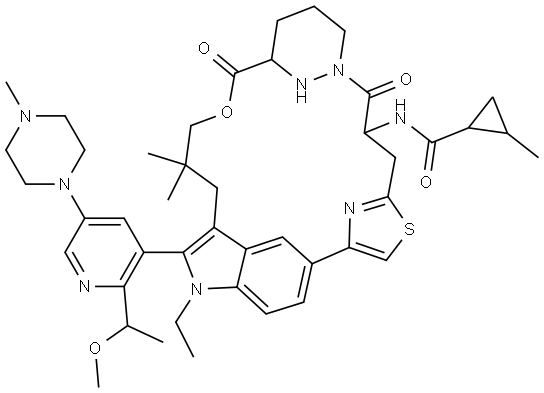

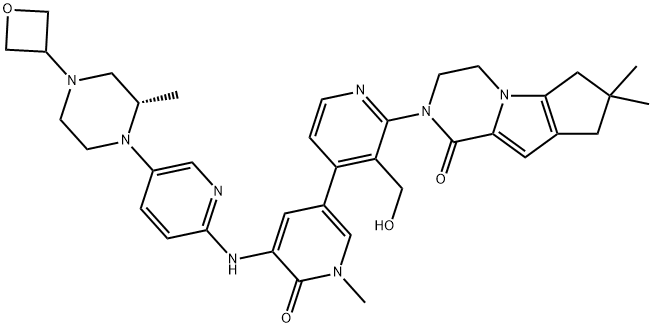
Fenebrutinib (GDC‑0853, RG7845) is a potent, selective, orally available, and non‑covalent Bruton‘s tyrosine kinase (BTK) inhibitor developed by Roche/Genentech. Structurally, Fenebrutinib features a complex fused heterocyclic core with a hydroxymethyl‑substituted bipyridinyl scaffold, a piperazinyl‑oxetanyl substituent, and a cyclopenta‑pyrrolo‑pyrazinone moiety.
Fenebrutinib is a next‑generation, non‑covalent BTK inhibitor being developed for the treatment of autoimmune diseases, most notably rheumatoid arthritis and systemic lupus erythematosus. Unlike covalent BTK inhibitors that irreversibly bind to Cys481, Fenebrutinib binds non‑covalently to BTK, offering the potential for improved safety profiles and activity against BTK mutations that confer resistance to covalent inhibitors. Fenebrutinib inhibits anti‑IgM antibody‑induced BTK phosphorylation in B cells with an IC₅₀ of 3.1 nM and inhibits anti‑IgM‑ or CD40L‑induced B cell proliferation with IC₅₀ values of 1.2 and 1.4 nM, respectively. Fenebrutinib demonstrates exceptional selectivity for BTK over a panel of 287 additional kinases at 1 µM, underscoring the therapeutic potential of this non‑covalent BTK inhibitor in autoimmune and inflammatory diseases.
Product Parameters
Parameter
Specification
Product Name
Fenebrutinib
CAS Number
1434048-34-6
Molecular Formula
C₃₇H₄₄N₈O₄
Molecular Weight
664.8 g/mol
Appearance
White solid powder
Melting Point
936.3±65.0 °C(Predicted)
pKa
13.15±0.10
Storage Condition
−20 °C
Bioactivity
Fenebrutinib (GDC-0853) is an effective, selective non-covalent BTK inhibitor with a Ki value of 0.91 nM for BRK. Its IC50 value against BTK is more than 100 times higher than that against the other three off-target kinases (Bmx: 153-fold; Fgr: 168-fold; Src: 131-fold).
In Vitro Study
Biochemical screening of a broad-spectrum human kinase library using 1 μM GDC-0853 revealed that among 286 off-target kinases, GDC-0853 exhibited inhibitory effects only against three specific enzymes, with significantly higher selectivity and potency toward BTK compared to the other three kinases (Bmx, Fgr, Src). GDC-0853 inhibits both B-cell BCR signaling and monocyte FcγR signaling. The average binding duration of GDC-0853 to BTK was 18.3 ± 2.8 hours. GDC-0853 also suppresses autophosphorylation of both wild-type BTK and the C481S mutant in cells. In vitro, treatment of chronic lymphocytic leukemia cells with GDC-0853 followed by BCR signal stimulation reduced BTK phosphorylation levels and attenuated activation of downstream targets such as PLCγ2, AKT, and ERK. GDC-0853 inhibits NF-κB-dependent transcription, diminishes its activation, and prevents cell migration. Intracellularly, GDC-0853 showed no inhibitory effect on EGFR or ITK and did not affect T-cell receptor activation.
In Vivo Studies
In rats, pharmacokinetic characteristics of GDC-0853 were evaluated following intraperitoneal administration at 0.2 mg/kg or oral administration at 1 mg/kg: GDC-0853 exhibited a moderately high clearance rate (CL = 27.4 mL/min/kg), good bioavailability (F = 65%), a distribution volume (Vd) of 5.42 L/kg, and a half-life (t1/2) of 2.2 hours. GDC-0853 also demonstrated favorable pharmacokinetic profiles in dogs, with a half-life of 3.8 hours, CLp = 10.9 mL/min/kg, Vd = 2.96 L/kg, and high oral bioavailability, enabling toxicological studies in dogs to achieve exposure levels comparable to those in rats. GDC-0853 was well tolerated in both rats and dogs. The drug showed efficacy in treating rheumatoid arthritis and other B-cell-or bone marrow cell-mediated autoimmune diseases in animal models. In single-dose escalation studies (0.5 mg–600 mg) and multiple-dose escalation studies (250 mg twice daily [BID]–500 mg once daily [QD]) over 14 days, GDC-0853 was well tolerated without severe adverse effects or dose-limiting toxicity. It exhibited excellent absorption and demonstrated linear, dose-proportional pharmacokinetic characteristics. In Sprague-Dawley rats, administration of GDC-0853 or other structurally diverse BTK inhibitors (for 7 days or longer) induces pancreatic lesions characterized by multifocal central hemorrhages in islets, inflammation, fibrosis, and the presence of pigmented macrophages, along with atrophy, degeneration, and inflammatory responses in adjacent lobular exocrine acinar cells. Such reactions have not been observed in mice or dogs—even when higher concentrations are administered—and are species-specific to SD rats.
Contact Us
Need Fenebrutinib for your BTK inhibitor research program? Contact Cosperpharm today for pricing, documentation, and technical support.
Hot Tags: Fenebrutinib, China, Manufacturer, Supplier, Factory
We use cookies to offer you a better browsing experience, analyze site traffic and personalize content. By using this site, you agree to our use of cookies.Privacy Policy