
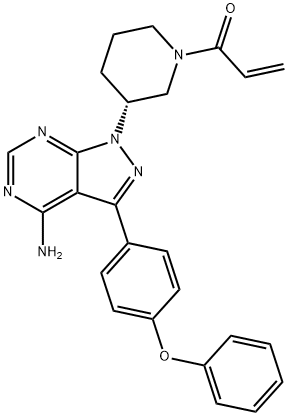
Ibrutinib (PCI‑32765) is a first‑in‑class, orally bioavailable, irreversible small‑molecule inhibitor of Bruton‘s tyrosine kinase (BTK). Structurally, Ibrutinib features a pyrazolo[3,4‑d]pyrimidine core with a 4‑phenoxyphenyl substituent at the 3‑position, an aminopyrimidine moiety, and a piperidine ring bearing an acrylamide Michael acceptor. This molecular architecture enables Ibrutinib to form a covalent bond with Cys481 in the ATP‑binding pocket of BTK through the acrylamide warhead, resulting in irreversible enzyme inhibition.
Ibrutinib is a first‑in‑class, irreversible BTK inhibitor that has transformed the treatment landscape for B‑cell malignancies. As a targeted covalent drug, Ibrutinib forms a covalent bond with Cys481 in the ATP‑binding pocket of BTK, leading to potent and sustained enzyme inhibition. Ibrutinib demonstrates an IC₅₀ of 0.5 nM for BTK and is selective for BTK against a screening panel of kinase enzymes. Ibrutinib inhibits BTK autophosphorylation, phosphorylation of PLCγ, and phosphorylation of ERK, thereby preventing B‑cell activation and B‑cell‑mediated signaling. Ibrutinib is approved for mantle cell lymphoma, chronic lymphocytic leukemia, Waldenström‘s macroglobulinemia, and chronic graft‑versus‑host disease, representing one of the most successful examples of targeted covalent drug discovery.
Product Parameters
Parameter
Specification
Product Name
Ibrutinib
CAS Number
936563-96-1
MDL Number
MFCD20261150
Molecular Formula
C₂₅H₂₄N₆O₂
Molecular Weight
440.5 g/mol
Appearance
White solid
Melting Point
153 – 158 °C
Boiling Point
715.0 ± 60.0 °C (predicted)
Density
1.34
Storage Condition
-20℃
Bruton's tyrosine kinase (BTK) inhibitors
Ibrutinib is a Bruton's tyrosine kinase (BTK) inhibitor indicated for the treatment of chronic lymphocytic leukemia (CLL) and mantle cell lymphoma (MCL). Both MCL and CLL are B-cell non-Hodgkin lymphomas characterized by refractory nature and high recurrence rates. Conventional chemotherapeutic regimens lack specificity and often induce grade 3 or 4 adverse reactions. Ibrutinib selectively binds to BTK, which is essential for the formation, differentiation, signaling, and survival of B lymphocytes, irreversibly inhibiting BTK activity and effectively suppressing tumor cell proliferation and viability. It exhibits rapid oral absorption, reaching peak plasma concentrations within 1–2 hours, with adverse effects classified as grade 1 or 2, positioning it as a novel therapeutic option for CLL and MCL. On November 13,2013, the U.S. Food and Drug Administration (FDA) granted accelerated approval under the Chemicalbook program to Imbruvica (brand name: Ibrutinib) developed by Pharmacyclics and Johnson & Johnson for the treatment of the rare aggressive hematologic malignancy—mantle cell lymphoma (MCL). Ibrutinib represents a first-in-class oral BTK inhibitor and was awarded Breakthrough Therapy Designation by the FDA in February 2013, followed by approval as a treatment for MCL on November 13,2013, and for CLL on February 12,2014. This drug selectively binds covalently to the cysteine residue (Cys-481) at the active site of the target protein Btk, irreversibly inhibiting BTK activity and thereby effectively preventing tumor migration from B cells to lymphoid tissues adapted to the tumor growth microenvironment.
Chronic lymphocytic leukemia (CLL) and mantle cell lymphoma (MCL)
Chronic lymphocytic leukemia (CLL) is a chronic hematologic malignancy characterized by the failure of morphologically mature lymphocytes to undergo normal apoptosis, leading instead to clonal proliferation within lymphoid tissues. CLL exhibits a certain degree of familial inheritance and represents one of the most common subtypes of B-cell non-Hodgkin lymphoma (NHCL). Mantle cell lymphoma (MCL) is a rare B-cell NHL accounting for approximately 5%–10% of all NHL cases, sharing both the refractory nature and aggressive behavior typical of malignant lymphomas. MCL is challenging to diagnose, with about 85% of patients diagnosed at advanced stages (stage III–IV); it is also prone to recurrence and has the lowest long-term survival rate among lymphoma subtypes. Clinical manifestations often include high fever, fatigue, splenomegaly, lymphadenopathy, gastrointestinal involvement, and neurological infiltration.
The current first-line treatment regimen for CLL is the FCR regimen, which combines fludarabine (F), cyclophosphamide (C), and rituximab (R). This regimen demonstrates certain efficacy, but the progression-free survival rate is only 38%, and grade 3 or 4 adverse reactions are occasionally observed. For MCL, anthracyclines or drugs containing high doses of cytarabine are commonly employed; however, these agents are generally insensitive to conventional chemotherapy regimens. Despite the use of numerous therapeutic options, overall patient survival has not been significantly prolonged [5]. Although combination chemotherapy regimens combining drugs with monoclonal antibodies have been adopted for MCL treatment, they exhibit significant toxicity, with an infection incidence of approximately 14% and a grade 3–4 adverse reaction rate as high as 87%. Therefore, there is a need for the development of more viable treatment strategies and highly effective, safe therapeutic agents.
Metabolism and Elimination
Ibrutinib is primarily metabolized by cytochrome P450 enzymes (CYP3A and, to a lesser extent, CYP2D6), yielding various metabolites. Among these, the active metabolite PCI-45227 is a dihydrodiol compound with inhibitory activity against BTK. Compared to ibutinib, this metabolite exhibits stronger BTK inhibition, approximately 15 times greater than that of ibutinib. Under steady-state conditions, the average metabolic rate of PCI-45227 ranges from 1 to 2 Chermat8. The apparent clearance (CL/F) of ibutinib is approximately 1000 L/h, with a half-life (t1/2) of 4–6 hours. Ibutinib is predominantly present in the body as metabolites and excreted via feces. In studies involving oral administration of radiolabeled ibutinib labeled with ¹⁴C to healthy subjects, nearly 90% of the radioactivity was eliminated within 168 hours; the majority (approximately 80%) was excreted via feces, about 10% via urine, and approximately 1% unchanged via feces.
The elimination of ibrutinib does not vary with age (37–84 years) or gender; however, systemic exposure is six times higher in patients with moderate hepatic impairment compared to healthy subjects.
Contact Us
Need Ibrutinib for your BTK inhibitor program, ANDA filing, or research application? Contact Cosperpharm today for pricing, documentation, and technical support.
Hot Tags: Ibrutinib, China, Manufacturer, Supplier, Factory
We use cookies to offer you a better browsing experience, analyze site traffic and personalize content. By using this site, you agree to our use of cookies.Privacy Policy