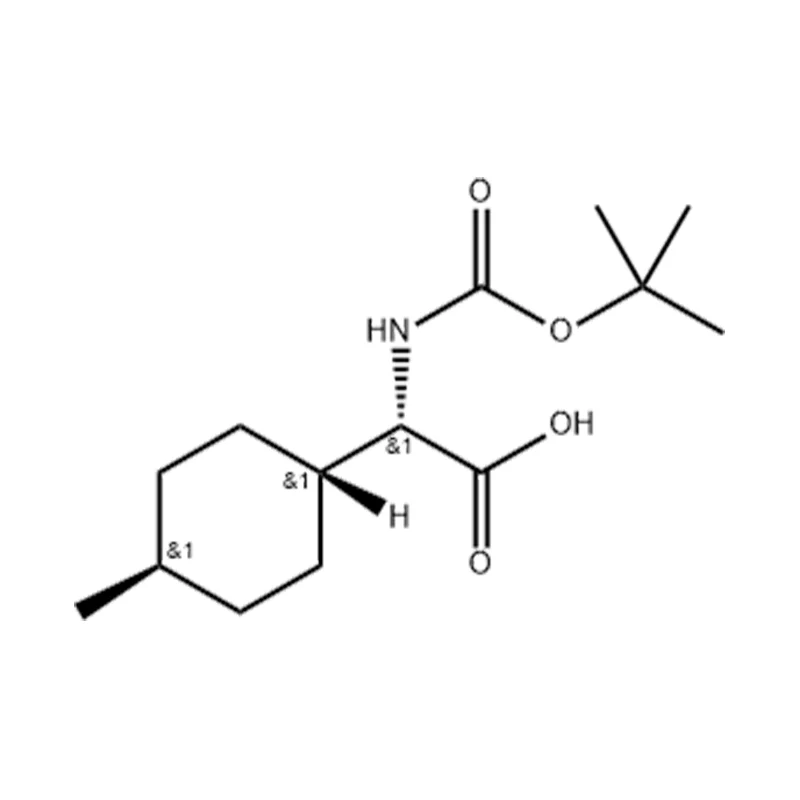
(S)-2-((tert-Butoxycarbonyl)amino)-2-(trans-4-methylcyclohexyl)acetic acid (CAS 1187224-06-1) is a chiral, Boc-protected non-natural amino acid derivative featuring a tert-butoxycarbonyl (Boc) protected α-amino group and a trans-4-methylcyclohexyl substituent at the α-carbon. The molecule incorporates a stereocenter at the α-carbon with defined (S)-configuration, making it a valuable chiral building block for pharmaceutical synthesis.
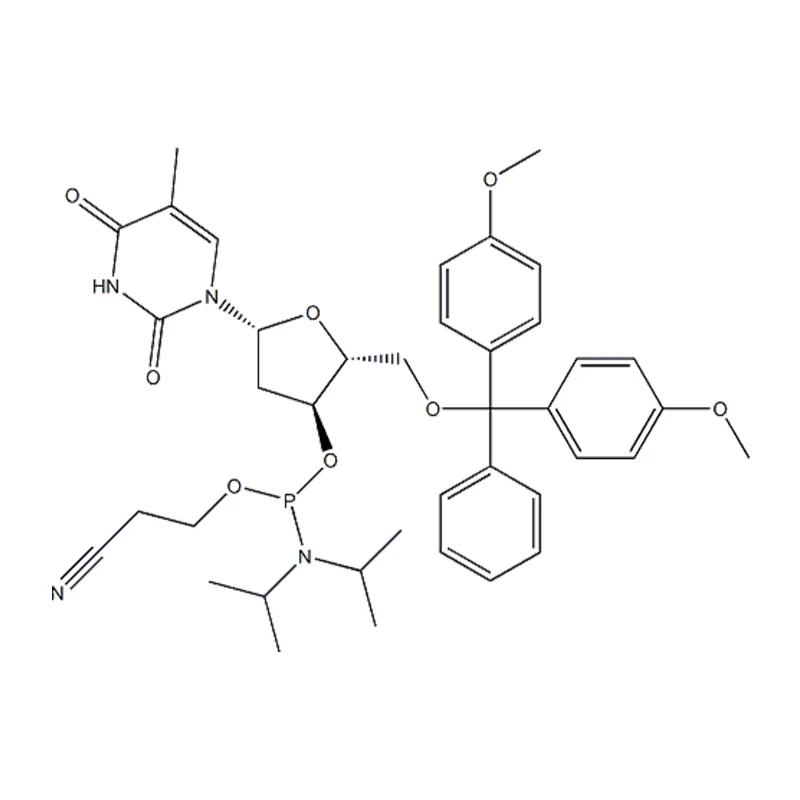
The product is DMT-dT-CE-Phosphoramidite (5'-O-(4,4'-Dimethoxytrityl)-thymidine-3'-O-[(2-cyanoethyl)-(N,N-diisopropyl)]-phosphoramidite). Structurally, it is a deoxythymidine (dT) nucleoside building block, featuring a 5'-O-dimethoxytrityl (DMT) group that protects the 5'-hydroxyl and a 3'-O-[(2-cyanoethyl)-(N,N-diisopropyl)]-phosphoramidite group that activates the 3'-position for chain elongation. DMT-dT-CE-Phosphoramidite is the standard monomer for introducing thymine residues, a critical component for base pairing with adenine (A) in DNA duplexes. This design makes DMT-dT-CE-Phosphoramidite a foundational and essential tool in solid-phase oligonucleotide synthesis (SPOS).
The product is 4,4,5,5-Tetramethyl-2-(2-methyl-[1,1'-biphenyl]-3-yl)-1,3,2-dioxaborolane, a biphenylboronic acid pinacol ester in which the boron atom is attached to the 3‑position of a 2‑methyl‑1,1'‑biphenyl scaffold. The ortho‑methyl group and the adjacent phenyl ring create a sterically demanding environment around the carbon–boron bond, while the pinacol ester imparts bench stability and controlled reactivity. This compound serves as a direct Suzuki–Miyaura coupling partner for the introduction of a functionalized, non‑planar biphenyl motif into drug candidates and advanced materials.
3-Azaspiro[5.5]undecan-9-one, 3-(phenylmethyl)- features a sterically defined spiro[5.5]undecane core in which a nitrogen atom is embedded at the 3‑position of one ring and a carbonyl group resides at the 9‑position of the other, with a benzyl substituent attached to the nitrogen. This architecture creates a distinctive rigid, non‑planar geometry in which the two cyclohexane‑type rings are locked orthogonal to each other by the shared quaternary carbon, while the piperidine‑like ring containing the ketone and the benzyl‑bearing aza‑ring project functionality into three‑dimensional space. The benzyl group introduces aromatic character and lipophilicity to an otherwise saturated scaffold, making the molecule a valuable intermediate for fine‑tuning lipophilic contacts within biological targets. Because the spirocyclic framework restricts bond rotation and fixes the relative orientation of the amine and ketone, it is particularly attractive for fragment‑based drug discovery and the construction of conformationally constrained analogues of bioactive amines.
3-[2-Chloro-5-(trifluoromethoxy)phenyl]-3-azaspiro[5.5]undecane-9-acetic acid is a highly elaborated spirocyclic phenylacetic acid that integrates an electron‑deficient 2‑chloro‑5‑(trifluoromethoxy)phenyl ring, a basic spiro‑piperidine nitrogen, and a flexible acetic acid side chain attached to the distal cyclohexane ring. The simultaneous presence of chlorine and a trifluoromethoxy group on the aromatic portion lowers electron density, enhances lipophilicity, and improves metabolic stability—attributes that often translate into improved target engagement and sustained pharmacokinetics. The spiro junction locks the relative orientation of the aromatic pharmacophore and the carboxylate, producing a well‑defined exit vector that allows medicinal chemists to precisely position the acid group within a binding site, all while maintaining the three‑dimensionality that differentiates this molecule from flat, aromatic‑rich acids.
2-(3-(TERT-BUTOXYCARBONYL)-3-AZASPIRO[5.5]UNDECAN-9-YL)ACETIC ACID is a bifunctional spirocyclic building block in which a Boc-protected 3-azaspiro[5.5]undecane core is substituted at the 9-position with an acetic acid moiety. The spiro junction fuses a piperidine ring and a cyclohexane ring through a single quaternary carbon, enforcing a near-orthogonal orientation between the two rings. The tert-butoxycarbonyl group masks the secondary amine within the piperidine ring, while the pendant acetic acid extends outward from the cyclohexane ring, providing two chemically orthogonal reactive handles separated by a rigid, fully saturated framework. This structural arrangement establishes a well-defined distance and angle between the protected amine and the carboxylic acid, making the molecule a geometrically predictable scaffold for constructing more complex entities.
Cosper is a professional Intermediate manufacturer and supplier in China. We have an experienced sales team, professional technicians, and an after-sales service team.
We use cookies to offer you a better browsing experience, analyze site traffic and personalize content. By using this site, you agree to our use of cookies. Privacy Policy


![4,4,5,5-Tetramethyl-2-(2-methyl-[1,1'-biphenyl]-3-yl)-1,3,2-dioxaborolane](https://www.cosperpharma.com/upload/8820/4-4-5-5-tetramethyl-2-2-methyl-1-1-biphenyl-3-yl-1-3-2-dioxaborolane-199456.webp "4,4,5,5-Tetramethyl-2-(2-methyl-[1,1'-biphenyl]-3-yl)-1,3,2-dioxaborolane")
![3-Azaspiro[5.5]undecan-9-one, 3-(phenylmethyl)-](https://www.cosperpharma.com/upload/8820/3-azaspiro-5-5-undecan-9-one-3-phenylmethyl--984528.webp "3-Azaspiro[5.5]undecan-9-one, 3-(phenylmethyl)-")
![3-[2-Chloro-5-(trifluoromethoxy)phenyl]-3-azaspiro[5.5]undecane-9-acetic acid](https://www.cosperpharma.com/upload/8820/3-2-chloro-5-trifluoromethoxy-phenyl-3-azaspiro-5-5-undecane-9-acetic-acid-739949.webp "3-[2-Chloro-5-(trifluoromethoxy)phenyl]-3-azaspiro[5.5]undecane-9-acetic acid")
![2-(3-(TERT-BUTOXYCARBONYL)-3-AZASPIRO[5.5]UNDECAN-9-YL)ACETIC ACID](https://www.cosperpharma.com/upload/8820/2-3-tert-butoxycarbonyl-3-azaspiro-5-5-undecan-9-yl-acetic-acid-273341.webp "2-(3-(TERT-BUTOXYCARBONYL)-3-AZASPIRO[5.5]UNDECAN-9-YL)ACETIC ACID")