
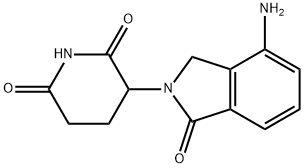
Lenalidomide is a potent immunomodulatory agent that inhibits the secretion of pro‑inflammatory cytokines and increases the secretion of anti‑inflammatory cytokines from peripheral blood mononuclear cells. As a thalidomide analogue, Lenalidomide exerts its cellular activities through its target cereblon, a component of the cullin‑RING E3 ubiquitin ligase enzyme complex. The compound is more soluble in organic solvents and low pH solutions compared to thalidomide, offering improved pharmaceutical properties. Lenalidomide is also a valuable building block for constructing small molecules for targeted protein degradation and PROTAC (proteolysis‑targeting chimeras) technology. As a high‑purity reference standard, Lenalidomide is indispensable for analytical method development, impurity profiling, quality control testing, and ANDA filings for generic lenalidomide manufacturers. Additionally, Lenalidomide serves as a critical tool compound for studying immunomodulation, cereblon biology, and developing novel targeted protein degradation therapies.
Product Parameters
|
Parameter |
Specification |
|
Product Name |
Lenalidomide |
|
CAS Number |
191732-72-6 |
|
Molecular Formula |
|
|
Molecular Weight |
|
|
Physical Form |
|
|
Appearance |
|
|
Melting Point |
265 268°C |
|
Boiling Point |
614.0±55.0°C (Predicted) |
|
Density |
1.460±0.06 g/cm³ (Predicted) |
|
pKa |
|
|
Solubility |
|
|
Storage Condition |
2 8°C |
Mechanism Of Action
Bioactivity
Antitumor Drug
Lenalidomide is a next-generation derivative of thalidomide, yet no teratogenic toxicity has been observed, and its efficacy is 100 times stronger than that of thalidomide. According to Phase III clinical trial results, lenalidomide is currently the most effective drug for treating multiple myeloma, with over half of patients experiencing survival extension exceeding three years after treatment. Additionally, it is the only medication capable of effectively treating myelodysplastic syndrome (MDS); clinical data indicate that 64% of MDS patients require no further blood transfusions following lenalidomide therapy.
In December 2005, the U.S. Food and Drug Administration (FDA) approved lenalidomide for the treatment of myelodysplastic syndrome (MDS).
In March 2006, the FDA approved lenalidomide, manufactured by U.S.-based Celgene Biopharmaceuticals, for the treatment of multiple myeloma (MM).
On September 23,2011, the European Medicines Agency (EMA) issued a statement confirming that lenalidomide (brand name: Revlimid) demonstrated a benefit outweighing risk in its approved patient population, while simultaneously warning physicians about the potential risk of inducing new-onset cancer. Lenalidomide was administered in combination with dexamethasone for adult patients with multiple myeloma who had received at least one prior treatment. Three new studies demonstrated an increased incidence of new-onset cancer in patients with newly diagnosed multiple myeloma receiving lenalidomide alongside other combination therapies.
Contact Us
Address
No. 2 Yangguang 3rd Road, Duodao Chemical Cycle Industrial Park, Jingmen City, Hubei Province, China
Tel