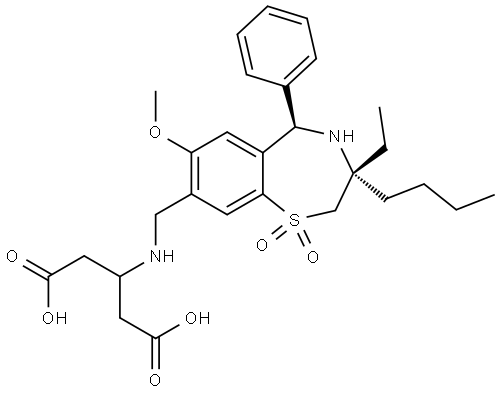
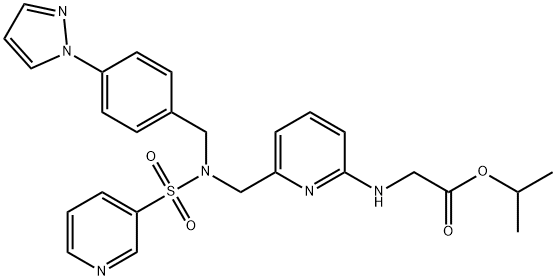
Linerixibat is an oral, minimally absorbed ileal bile acid transporter (IBAT) inhibitor developed for the treatment of cholestatic pruritus in patients with primary biliary cholangitis (PBC) . Chemically, Linerixibat inhibits the ileal bile acid transporter, reducing bile acid reabsorption and thereby decreasing systemic bile acid levels, which are associated with the pruritus experienced by PBC patients .
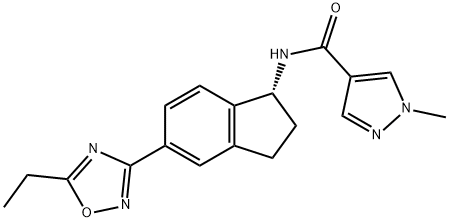
Aficamten (CAS 2364554-48-1), also known as CK-3773274, is a potent, next-generation cardiac myosin inhibitor designed for the treatment of hypertrophic cardiomyopathy (HCM) . Structurally, Aficamten is a pyrazole carboxamide derivative featuring an indane core with an ethyl-oxadiazole substituent . The molecule has the molecular formula C₁₈H₁₉N₅O₂ and contains a chiral center that contributes to its selective activity as a cardiac myosin inhibitor .
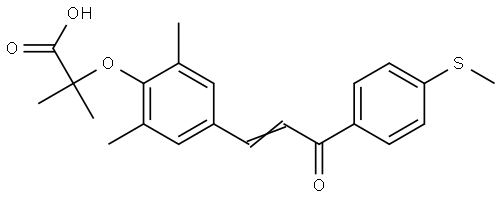
Elafibranor (CAS 824932-88-9), also known as GFT505, is a potent dual peroxisome proliferator-activated receptor (PPAR) α/δ agonist with significant therapeutic potential for metabolic disorders . Structurally, Elafibranor is a sulfonyl-containing carboxylic acid derivative with the molecular formula C₂₂H₂₄O₄S . The molecule features a conjugated system linking aromatic and sulfonyl-substituted rings, contributing to its high-affinity binding to PPARα and PPARδ.
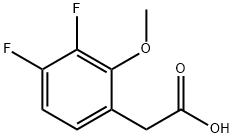
3,4-Difluoro-2-methoxyphenylacetic acid (CAS 1558274-26-2) is a specialized phenylacetic acid derivative featuring a distinctive substitution pattern on the aromatic ring. Structurally, 3,4-Difluoro-2-methoxyphenylacetic acid consists of a phenylacetic acid core with a methoxy group at the 2-position and fluorine atoms at the 3- and 4-positions of the benzene ring.
Omidenepag Isopropyl (CAS 1187451-19-9) is a selective, non-prostaglandin EP2 receptor agonist developed for the treatment of glaucoma and ocular hypertension. Chemically known as isopropyl (5-{[4-(1,3-benzothiazol-2-yl)piperazin-1-yl]carbonyl}-1,2-benzoxazol-3-yl)acetate, Omidenepag Isopropyl features a complex benzoxazole core linked to a piperazine-benzothiazole moiety via an amide bond.
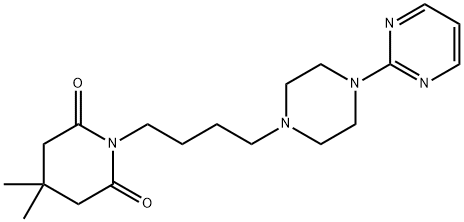
Gepirone (CAS 83928-76-1) is a selective 5-HT1A receptor partial agonist developed for the treatment of major depressive disorder. Chemically known as 4,4-dimethyl-1-[4-[4-(2-pyrimidinyl)piperazin-1-yl]butyl]piperidine-2,6-dione, Gepirone features a glutarimide core linked to a pyrimidinyl piperazine moiety via a butyl spacer.
We use cookies to offer you a better browsing experience, analyze site traffic and personalize content. By using this site, you agree to our use of cookies. Privacy Policy