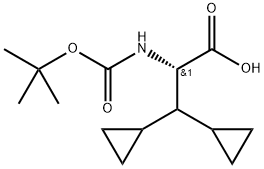
(S)-2-((tert-Butoxycarbonyl)amino)-3,3-dicyclopropylpropanoic acid (CAS 2548967-22-0) is a chiral, N-Boc-protected amino acid derivative featuring a distinctive 3,3-dicyclopropyl-substituted alanine scaffold. The molecular structure consists of a central stereogenic center at the α-carbon (S-configuration), an N-terminal tert-butoxycarbonyl (Boc) protecting group, and a carboxylic acid at the C-terminus.
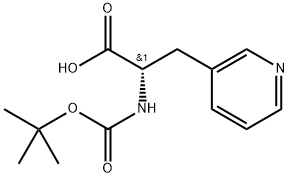
Boc-β-(3-pyridyl)-Ala-OH (Boc-3-(3-pyridyl)-L-alanine) is a Boc-protected unnatural amino acid featuring a 3-pyridyl group at the β-position of the alanine backbone. The molecule consists of an L-alanine core with a tert-butyloxycarbonyl (Boc) protecting group on the α-amino group, a free carboxylic acid at the C-terminus, and a 3-pyridyl substituent replacing the methyl group of natural alanine.
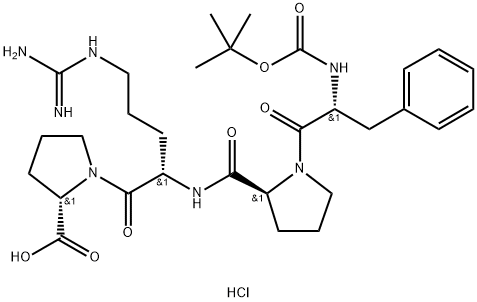
Boc-D-Phe-Pro-Arg-Pro-OH.HCl is a protected tetrapeptide consisting of four amino acid residues in the sequence D-Phe-Pro-Arg-Pro, with a tert-butyloxycarbonyl (Boc) protecting group at the N-terminus and the C-terminus as the free carboxylic acid, stabilized as the hydrochloride salt.
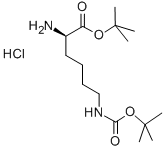
H-D-Lys(Boc)-OtBu.HCl is an orthogonally protected D-lysine derivative featuring a free α-amino group stabilized as the hydrochloride salt, a tert-butyloxycarbonyl (Boc) protecting group on the ε-amino side chain, and a tert-butyl ester (OtBu) at the C-terminus.
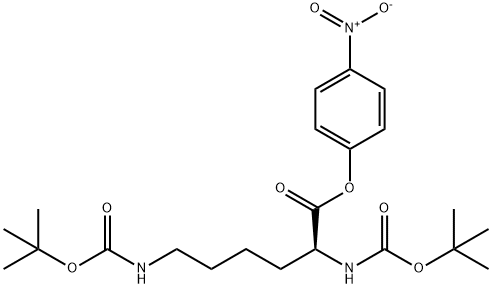
Boc-Lys(Boc)-ONp (Nα,ε-di-Boc-L-lysine 4-nitrophenyl ester) is a doubly protected lysine derivative featuring Boc protecting groups on both the α-amino and ε-amino groups, with a 4-nitrophenyl (ONp) ester activating the C-terminus.
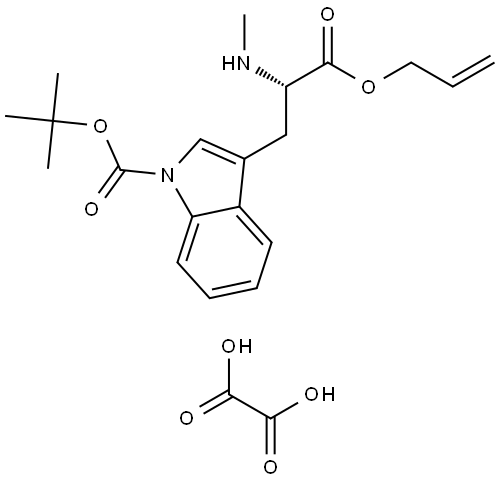
H-N-Me-Trp(Boc)-OAll Oxalate (tert-butyl (S)-3-(3-(allyloxy)-2-(methylamino)-3-oxopropyl)-1H-indole-1-carboxylate oxalate) is a specialized N-methylated tryptophan derivative featuring orthogonal protection of its three functional groups. The molecule incorporates an Nα-methyl group (H-N-Me), a Boc-protected indole nitrogen, and an allyl ester (OAll) protecting group at the C-terminus.
We use cookies to offer you a better browsing experience, analyze site traffic and personalize content. By using this site, you agree to our use of cookies. Privacy Policy