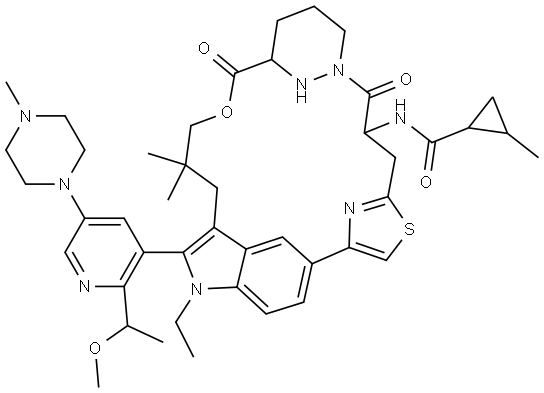
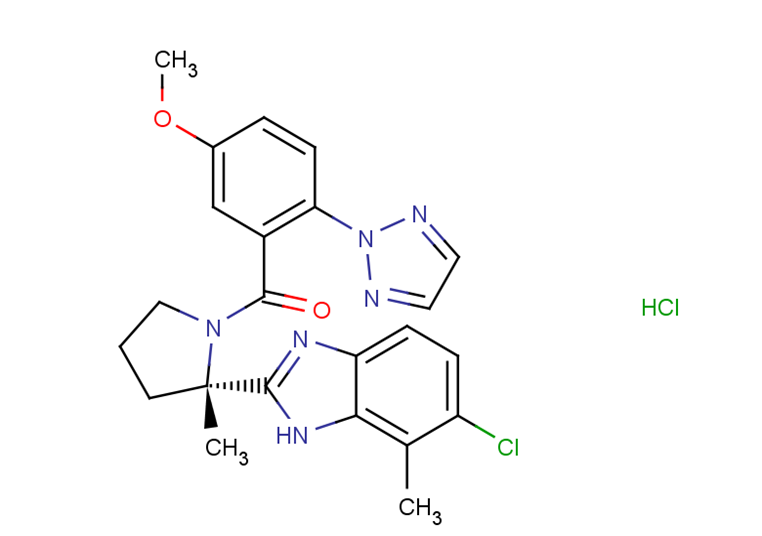
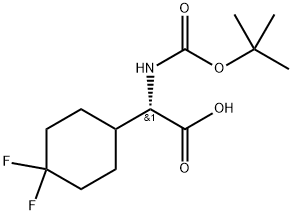
tert-Butoxycarbonylamino-(4,4-difluoro-cyclohexyl)-acetic acid (also known as (S)-2-((tert-Butoxycarbonyl)amino)-2-(4,4-difluorocyclohexyl)acetic acid or Boc-S-2-(4,4-difluorocyclohexyl)glycine) is a chiral, Boc-protected amino acid derivative featuring a stereospecific (S)-configuration at the α-carbon center.
(2S)-2-amino-6-((1-(6-nitrobenzo[d][1,3]dioxol-5-yl)ethoxy)carbonylamino)hexanoic acid is a photocaged lysine derivative featuring a complex molecular architecture that combines a chiral α-amino acid core with a photolabile nitrobenzodioxole (nitropiperonyl) protecting group. The molecule consists of an L-lysine backbone with the ε-amino group masked by a (1-(6-nitrobenzo[d][1,3]dioxol-5-yl)ethoxy)carbonyl moiety.
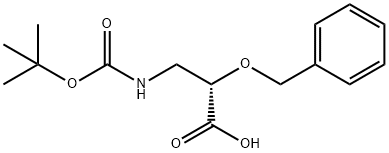
2-Benzyloxy-3-tert-butoxycarbonylamino-propionic acid (also known as 2-(Benzyloxy)-3-[(tert-butoxycarbonyl)amino]propanoic acid) is a dual-protected β-amino acid building block belonging to the isoserine family. Structurally, the molecule features a propanoic acid backbone with an α-benzyloxy substituent and a β-Boc-protected amine.
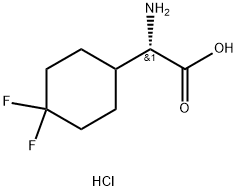
(2S)-2-amino-2-(4,4-difluorocyclohexyl)acetic acid hydrochloride is a chiral, non-proteinogenic α-amino acid derivative featuring a gem-difluorinated cyclohexyl ring at the β-position. The molecule consists of a glycine α-carbon bearing an amino group and a carboxylic acid, with a 4,4-difluorocyclohexyl substituent attached to the α-carbon. The hydrochloride salt form protonates the amino group, enhancing aqueous solubility and improving crystallinity and handling properties.
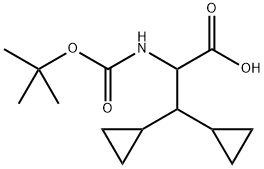
2-((tert-Butoxycarbonyl)amino)-3,3-dicyclopropylpropanoic acid (CAS 2272861-72-8) is an N-Boc-protected amino acid derivative featuring the distinctive 3,3-dicyclopropyl-substituted alanine scaffold. The molecular structure comprises an N-terminal tert-butoxycarbonyl (Boc) protecting group, a carboxylic acid at the C-terminus, and a geminal dicyclopropyl substitution at the β-position.
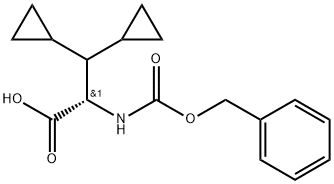
(S)-2-(((Benzyloxy)carbonyl)amino)-3,3-dicyclopropylpropanoic acid (CAS 2755148-69-5) is a chiral, N-Cbz-protected amino acid derivative featuring the distinctive 3,3-dicyclopropyl-substituted alanine scaffold. The molecular structure comprises a central stereogenic center at the α-carbon (S-configuration), an N-terminal benzyloxycarbonyl (Cbz or Z) protecting group, and a carboxylic acid at the C-terminus.
We use cookies to offer you a better browsing experience, analyze site traffic and personalize content. By using this site, you agree to our use of cookies. Privacy Policy


![(2S)-2-aMino-6-((1-(6-nitrobenzo[d][1,3]dioxol-5-yl)ethoxy)carbonylaMino)hexanoic acid](https://www.cosperpharma.com/upload/8820/-2s-2-amino-6-1-6-nitrobenzo-d-1-3-dioxol-5-yl-ethoxy-carbonylamino-hexanoic-acid-460141.png "(2S)-2-aMino-6-((1-(6-nitrobenzo[d][1,3]dioxol-5-yl)ethoxy)carbonylaMino)hexanoic acid")