4-Chloro-7-((2-(trimethylsilyl)ethoxy)methyl)-7H-pyrrolo[2,3-d]pyrimidine is an SEM (2-(trimethylsilyl)ethoxymethyl) protected derivative of 4-chloro-7H-pyrrolo[2,3-d]pyrimidine, a fused bicyclic heterocycle comprising a pyrrole ring fused to a pyrimidine ring — a structural motif that appears prominently in kinase inhibitor drug discovery. The electron-withdrawing chlorine at the 4-position provides a site for selective nucleophilic aromatic substitution (SNAr), enabling the introduction of various amine and alkoxy substituents. At the 7-position, the SEM group serves as a base-stable, acid-labile protecting group, allowing orthogonal deprotection under mild conditions. The trimethylsilyl subunit of 4-Chloro-7-((2-(trimethylsilyl)ethoxy)methyl)-7H-pyrrolo[2,3-d]pyrimidine introduces a silyl ether with distinctive lipophilic character, enhancing solubility in non-polar reaction media and facilitating purification by silica gel column chromatography.
The product is Methyl 4-(benzo[d][1,3]dioxol-5-yl)-2-(4-methoxyphenyl)pyrrolidine-3-carboxylate, a stereochemically well-defined 2,3,4-trisubstituted pyrrolidine bearing three distinctive structural motifs: a 3,4-methylenedioxyphenyl (benzodioxole) group at the C4 position, a 4-methoxyphenyl group at C2, and a methyl ester at C3. The pyrrolidine core offers a semi-rigid backbone that projects substituents into well-defined three-dimensional space — an arrangement highly valued in medicinal chemistry for modulating pharmacokinetic and pharmacodynamic properties. The benzodioxole unit, in particular, is a recurring heterocyclic fragment found in a number of endothelin (ET) receptor antagonists and other drug-like molecules, frequently contributing to enhanced selectivity and binding affinity. The electron-donating methoxy substituent on the pendant aryl ring, along with the ester functionality at the 3-position, positions Methyl 4-(benzo[d][1,3]dioxol-5-yl)-2-(4-methoxyphenyl)pyrrolidine-3-carboxylate as an advanced pharmaceutical intermediate amenable to further functionalization through ester hydrolysis, amidation, or N-alkylation.
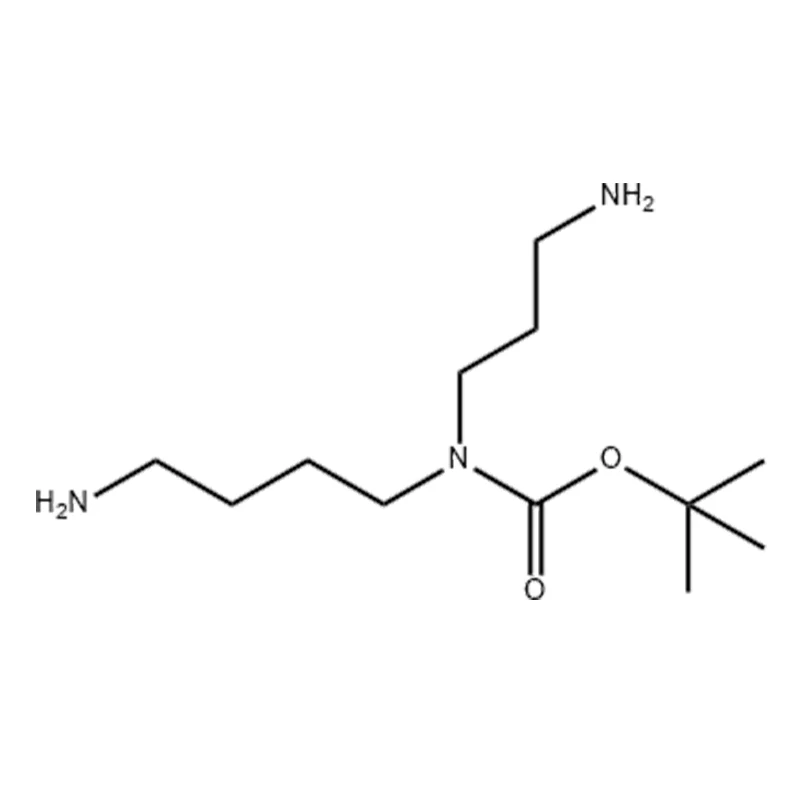
The molecular architecture of Carbamic acid, N-(4-aminobutyl)-N-(3-aminopropyl)-, 1,1-dimethylethyl ester (C₁₂H₂₇N₃O₂, MW 245.36) is constructed around a central tertiary carbamate (Boc, tert-butoxycarbonyl) core, where the nitrogen atom is symmetrically dialkylated with two flexible aminoalkyl chains: a 4-aminobutyl chain extending in one direction and a 3-aminopropyl chain in the other. The Boc group—a tert-butyl ester connected to the central nitrogen via a carbonyl (C=O) linkage—serves as a robust protecting group that masks the tertiary amine, rendering it inert toward nucleophilic substitution, oxidation, and basic conditions while remaining susceptible to selective cleavage under acidic conditions (e.g., TFA in dichloromethane). Each pendant chain terminates in a free primary amine (-NH₂) group, endowing Carbamic acid, N-(4-aminobutyl)-N-(3-aminopropyl)-, 1,1-dimethylethyl ester with two chemically equivalent yet sterically and geometrically distinct nucleophilic handles. The 4-aminobutyl chain provides a longer reach, while the 3-aminopropyl chain offers a more compact spatial profile; this asymmetry, combined with the predicted pKa of approximately 10.42 for the primary ammonium ions, enables pH-dependent, chemoselective derivatization strategies under carefully controlled conditions. The presence of three ionizable amine nitrogens (two primary, one Boc-protected tertiary) confers significant polarity, yet the lipophilic tert-butyl group contributes hydrophobic character (predicted LogP ~2.71, polar surface area 81.58 Ų), balancing solubility in both aqueous buffers and organic solvents. This combination of a Boc-protected tertiary amine scaffold with two differentiated primary amine arms makes Carbamic acid, N-(4-aminobutyl)-N-(3-aminopropyl)-, 1,1-dimethylethyl ester a versatile, trifunctional building block for the convergent assembly of complex molecular architectures.
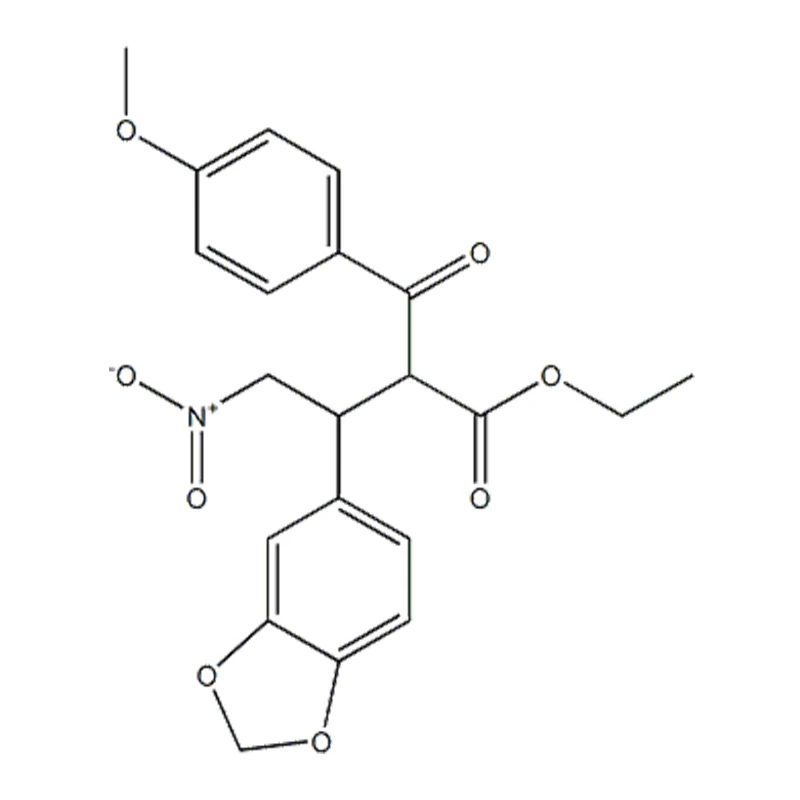
The compound is Ethyl 2-(4-Methoxybenzoyl)-3-(3,4-Methylenedioxy-phenyl)-4-nitro-butanoate, a multi-functionalized β-keto ester derivative that integrates three distinct pharmacophoric elements into a single molecular scaffold. Structurally, the molecule features a 4-methoxybenzoyl group that provides a planar aromatic motif suitable for hydrophobic recognition, a 3,4-methylenedioxyphenyl ring that contributes additional aromatic character and hydrogen-bonding potential via the dioxole oxygens, and a terminal nitrobutanoate chain that introduces both a reactive nitro group and an ethyl ester functionality. The methylenedioxy unit fused to the second phenyl ring — formally a benzodioxole system — is a structural signature found in several pharmaceutical agents, where it often contributes to enhanced metabolic stability and selective receptor binding. This combination of aromatic motifs, ester handle, and nitro group suggests that Ethyl 2-(4-Methoxybenzoyl)-3-(3,4-Methylenedioxy-phenyl)-4-nitro-butanoate is designed for downstream transformations, where the nitro group can serve as a precursor to amines or other nitrogen-containing functionalities, while the ester allows for hydrolysis or amide coupling under mild conditions.
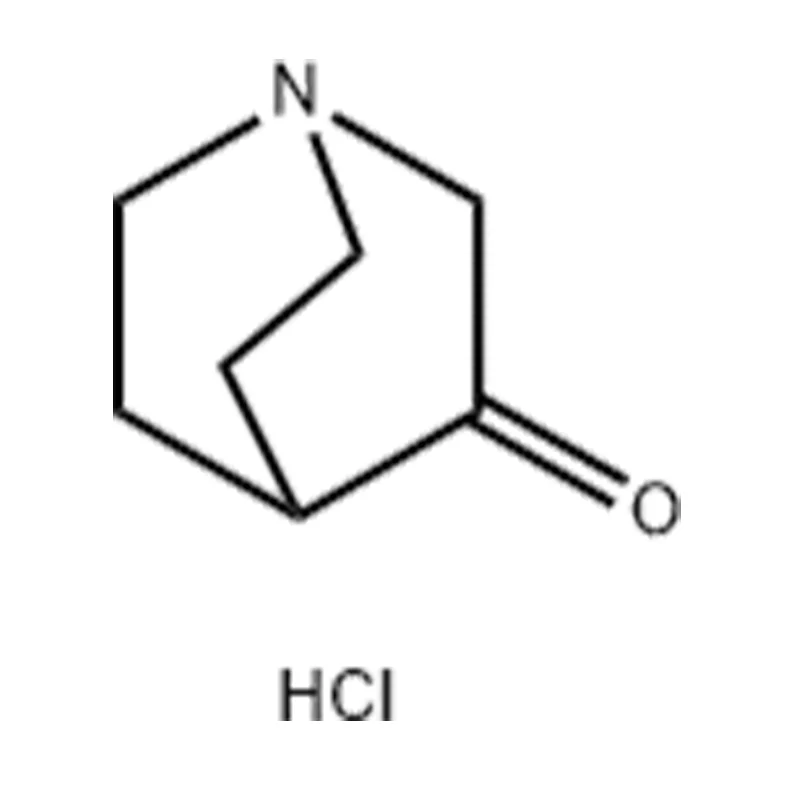
The product is 3-Quinuclidinone Hydrochloride , the protonated hydrochloride salt of 3-quinuclidinone, featuring a rigid bicyclic cage-like quinuclidine scaffold with a ketone group at the C3 position and a protonated tertiary amine stabilized by the chloride counterion. Structurally, the molecule consists of a bridgehead nitrogen atom at the apex of the bicyclo[2.2.2]octane framework, with a ketone carbonyl positioned at the 3-position of the rigid skeleton. This unique arrangement effectively pre‑organizes the functional groups in three‑dimensional space, creating a conformationally locked architecture that is highly valued in medicinal chemistry. The hydrochloride salt form protonates the tertiary amine, rendering 3-Quinuclidinone Hydrochloride freely soluble in water (0.1 g/mL at 20 °C) — a significant practical advantage over the neutral free base — while also improving crystallinity, long‑term storage stability, and laboratory handling. The rigid, cage‑like skeleton of 3-Quinuclidinone Hydrochloride reduces entropic penalties upon receptor binding, a property that has been successfully exploited in the design of several high‑affinity muscarinic receptor modulators, anticholinergic agents, and other CNS‑targeting therapeutics.
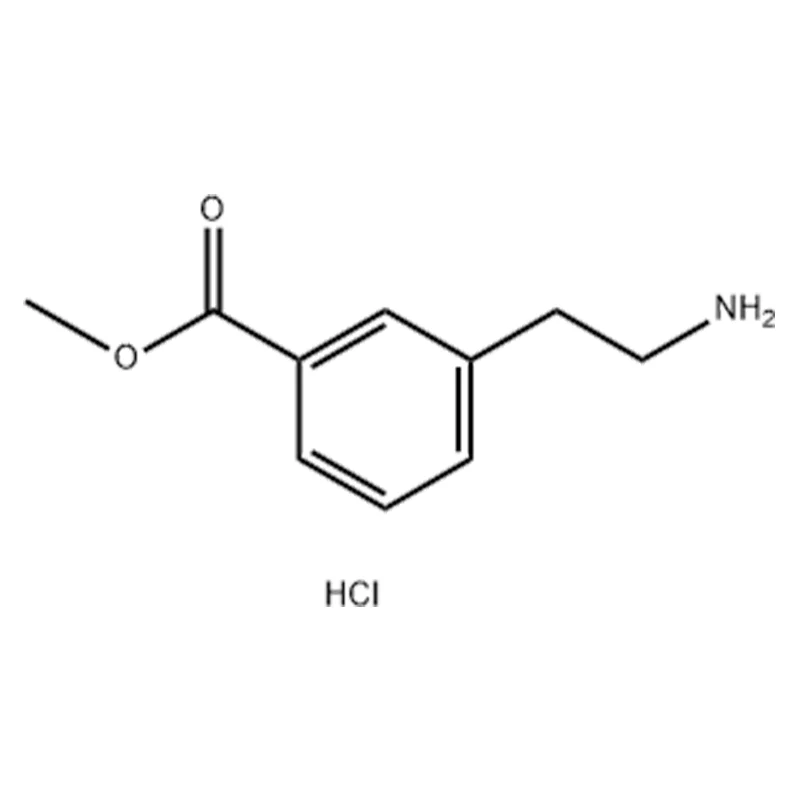
The product is Methyl 3-(2-Aminoethyl)benzoate Hydrochloride, a functionalized benzoate derivative featuring a methyl ester at the C1 position and a β-aminoethyl side chain at the C3 position of the benzene ring. Structurally, the molecule comprises three architecturally distinct domains: a hydrophobic methyl benzoate core that provides aromatic character and ester reactivity, a protonatable primary amine (present as the hydrochloride salt), and a two-carbon ethylene linker separating the amine from the aromatic ring. The hydrochloride salt form not only enhances aqueous solubility but also stabilizes the molecule against premature oxidation or condensation reactions during storage and handling. The meta relationship between the ester and the aminoethyl side chain creates an extended linear topology distinct from the ortho or para isomers, a structural feature that has been shown to influence biological activity profiles in the Hansl series of CNS-active agents. The methyl ester serves as a protecting group for the carboxylic acid, allowing selective manipulation of the amine functionality in downstream synthetic sequences, while the primary amine provides a versatile nucleophilic handle for amidation, reductive amination, or isothiocyanate formation.
We use cookies to offer you a better browsing experience, analyze site traffic and personalize content. By using this site, you agree to our use of cookies. Privacy Policy


![4-CHLORO-7-((2-(TRIMETHYLSILYL)ETHOXY)METHYL)-7H-PYRROLO[2,3-D]PYRIMIDINE](https://www.cosperpharma.com/upload/8820/4-chloro-7-2-trimethylsilyl-ethoxy-methyl-7h-pyrrolo-2-3-d-pyrimidine-523396.webp "4-CHLORO-7-((2-(TRIMETHYLSILYL)ETHOXY)METHYL)-7H-PYRROLO[2,3-D]PYRIMIDINE")
![Methyl 4-(benzo[d][1,3]dioxol-5-yl)-2-(4-methoxyphenyl)pyrrolidine-3-carboxylate](https://www.cosperpharma.com/upload/8820/methyl-4-benzo-d-1-3-dioxol-5-yl-2-4-methoxyphenyl-pyrrolidine-3-carboxylate-158519.webp "Methyl 4-(benzo[d][1,3]dioxol-5-yl)-2-(4-methoxyphenyl)pyrrolidine-3-carboxylate")