
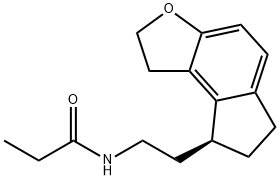
Ramelteon (CAS 196597-26-9) is a synthetic melatonin receptor agonist featuring a unique indeno-furan bicyclic scaffold fused to a propionamide side chain. The molecule is structurally derived from the endogenous hormone melatonin, with a rigid tricyclic framework that confers high affinity and selectivity for the MT₁ and MT₂ melatonin receptors.
Ramelteon is a potent, orally active, and highly selective melatonin receptor agonist used for the treatment of insomnia characterized by difficulty with sleep onset. As the first non‑scheduled hypnotic approved by the FDA, Ramelteon offers a distinct mechanism of action compared to traditional sedative‑hypnotics, binding preferentially to MT₁ and MT₂ receptors with high selectivity over the MT₃ receptor. Ramelteon is supplied as a crystalline solid with a molecular formula of C₁₆H₂₁NO₂ and a molecular weight of 259.35 g/mol. The synthetic indeno-furan scaffold of Ramelteon is derived from the natural hormone melatonin, and the compound has been extensively studied for its chronobiotic and hypnotic properties. Ramelteon is also available as a reference standard for analytical method development, method validation (AMV), quality control (QC) applications for Abbreviated New Drug Applications (ANDA), and commercial production.
Product Parameters
Parameter
Specification
Product Name
Ramelteon
CAS Number
196597-26-9
Molecular Formula
C₁₆H₂₁NO₂
Molecular Weight
259.34 g/mol
Physical Form
Solid / Crystalline solid
Melting Point
113-115 ℃
Boiling Point
455.3±24.0℃
Density
1.119±0.06
Storage Condition
Sealed in dry,Store in freezer, under -20°C
Mechanism Of Action
Ramelteonis a melatonin receptor agonist with high affinity for both MT1 and MT2 melatonin receptors, exhibiting specific and complete agonistic effects on these receptors while showing no interaction with the MT3 receptor. Additionally, it does not bind to neurotransmitter receptors such as the GABA receptor complex and does not interfere with the activity of most enzymes within a certain range. Consequently, it avoids the attention deficits associated with GABAergic drugs (which may lead to traffic accidents, falls, fractures, etc.) as well as drug addiction and dependence. Its primary metabolite, M-2, accounts for 20–100 times the total amount of the parent compound but exhibits lower activity; its affinities for MT1 and MT2 receptors are approximately 1/5 and 1/10 of those of the parent compound, respectively. Compared to the parent drug, its pharmacological activity is reduced by approximately 17–25-fold. Other metabolites of levetiramine are inactive.
Indications
1.Two randomized double-blind trials were conducted to evaluate the efficacy of this product in treating chronic insomnia. Patients aged 18–64 years with chronic insomnia were divided into two groups receiving either a single dose of the product or a placebo for 35 days, with polysomnography (PSG) performed at each measurement time point. Results showed that, compared to the placebo group, the sleep latency was shortened at all measurement time points in both groups. Another three-cycle crossover trial involving patients aged>65 years with a history of chronic insomnia who received either the product or placebo demonstrated similarly shortened sleep latency at all measurement time points compared to placebo, confirming its definitive therapeutic effect for chronic insomnia.
2.A randomized, double-blind, parallel-controlled trial evaluated the first-night effect of this drug in transient insomnia. PSG parameters were measured in healthy adult subjects after administration of the drug. Results demonstrated that a dose of 8 mg significantly shortened sleep latency compared to placebo, indicating its proven efficacy for short-term insomnia.
Drug Interaction
1.The effects of strong CYP1A2 inhibitors/facilitators on the metabolism of this drug are significant. Administration of the CYP1A2 inhibitor fluvoxamine 100 mg twice daily for 3 consecutive days followed by a single dose of 16 mg of this drug increased the Cmax and AUC of the drug by approximately 70-fold and 190-fold, respectively. When administered with the strong CYP3A4 inhibitor ketoconazole 200 mg twice daily on day 4 alongside a single dose of 16 mg of this drug, the AUC and Cmax of the drug increased by 84% and 36%, respectively, compared to monotherapy. The strong CYP2C9 inhibitor fluconazole elevated the AUC and Cmax of a single dose of 16 mg of this drug by approximately 150%. Administration of the strong CYP inducer rifampin 600 mg once daily for 11 days followed by a single dose of 32 mg of this drug resulted in an average reduction of 80% in both the AUC and Cmax of the drug and its metabolite M-II. Therefore, caution should be exercised when co-administering this drug with its metabolic enzyme inhibitors/facilitators, and dosage adjustments should be made accordingly; concomitant use with strong CYP1A2 inhibitors such as fluvoxamine is strictly prohibited.
2.Effects on the metabolism of other drugs: This product does not exhibit competitive inhibitory effects when co-administered with omeprazole, dextromethorphan, midazolam, theophylline, digoxin, or chlorpromazine.
Contact Us
Need a reliable supply of Ramelteon for your insomnia drug manufacturing campaign, impurity profiling program, or chronobiology research? Cosperpharm makes it straightforward. Reach out to our team today for pricing, documentation, or technical support — we are ready to assist with your pharmaceutical and research needs.
Hot Tags: Ramelteon, China, Manufacturer, Supplier, Factory
We use cookies to offer you a better browsing experience, analyze site traffic and personalize content. By using this site, you agree to our use of cookies.Privacy Policy