
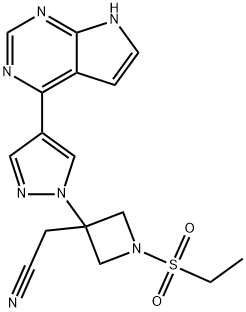
Baricitinib (CAS 1187594-09-7), chemically identified as 2-[1-ethylsulfonyl-3-[4-(7H-pyrrolo[2,3-d]pyrimidin-4-yl)pyrazol-1-yl]azetidin-3-yl]acetonitrile, is a small molecule Janus kinase (JAK) inhibitor. Structurally, Baricitinib features a pyrrolo[2,3-d]pyrimidine core linked to a pyrazole ring, which is further connected to an azetidine ring bearing an ethylsulfonyl group and an acetonitrile substituent.
Baricitinib is a selective and reversible Janus kinase 1 (JAK1) and 2 (JAK2) inhibitor. Janus kinases belong to the tyrosine protein kinase family and play an important role in the proinflammatory pathway signalling that is frequently over-activated in autoimmune disorders such as rheumatoid arthritis. Baricitinib has nanomolar potency against JAK1 (IC₅₀ = 5.9 nM) and JAK2 (IC₅₀ = 5.7 nM), and also inhibits Tyk2 (IC₅₀ = 53 nM). Baricitinib modulates immune signaling by suppressing cytokine release. While primarily used in autoimmune diseases and COVID-19-related cytokine storm management, Baricitinib is gaining interest in neuroinflammation research. Baricitinib appears as a class white to off-white crystalline powder, odorless and tasteless.
Product Parameters
Parameter
Specification
Product Name
Baricitinib
CAS Number
1187594-09-7
Molecular Formula
C₁₆H₁₇N₇O₂S
Molecular Weight
371.42 g/mol
Appearance
White solid
Melting Point
212-215 ℃
Storage Condition
-20℃
Density
1.56
Mechanism Of Action
Baricitinib (olumiant) is a selective JAK2 and JAK1 inhibitor with limited efficacy against Janus kinase, Jak3, or TYK2. These kinases and their associated signal transduction and transcriptional activator pathways (JAK-STAT) constitute the primary intracellular mechanisms governing the amplitude and duration of cytokine signaling via type I and type II cytokine receptors. These receptors lack intrinsic enzymatic activity-mediated signal transduction; Janus kinase signaling and transcriptional activation occur through JAK enzyme phosphorylation, leading to STAT activation. Several inflammatory cytokines, including IL-6 and granulocyte-macrophage colony-stimulating factor (GM-CSF), are involved in the pathogenesis of rheumatoid arthritis (RA). Interferon signaling also operates via the JAK-STAT pathway. Consequently, JAK1 and JAK2 inhibitors can target multiple RA-related cytokine pathways, thereby reducing the activation and proliferation of key immune cells involved in inflammation. Baricitinib exhibits no effect on JAK3, which is likely associated with conventional γ-chain receptors. Common γ-chain-dependent cytokines include IL-15 and IL-21, primarily regulating lymphocyte activation, function, and proliferation.
Adverse Reaction
The most common adverse reactions include headache, upper respiratory tract infections, and nasopharyngitis; no opportunistic infections, tuberculosis infections, or gastrointestinal perforations were observed.
Indication
1. Baricitinib is indicated for the treatment of moderate to severe active rheumatoid arthritis (RA) in adults, particularly in patients who are intolerant to one or more antirheumatic agents. It may be administered as monotherapy or in combination with methotrexate. The efficacy of baricitinib in treating psoriasis, diabetic nephropathy, atopic dermatitis, systemic lupus erythematosus, and other conditions is currently under investigation in Phase II clinical trials.
2. For use in scientific research and the field of chemical reagents
Contact Us
Need Baricitinib for your JAK inhibitor research or autoimmune disease study? Cosperpharm is ready to supply — get in touch today.
Hot Tags: Baricitinib, China, Manufacturer, Supplier, Factory
We use cookies to offer you a better browsing experience, analyze site traffic and personalize content. By using this site, you agree to our use of cookies.Privacy Policy