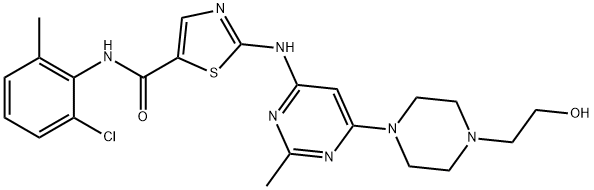
Dasatinib is a pivotal second-generation tyrosine kinase inhibitor and certified reference standard widely used in the treatment of chronic myeloid leukemia and Philadelphia chromosome-positive acute lymphoblastic leukemia. As the active pharmaceutical ingredient marketed as Sprycel®, Dasatinib is indicated for patients with imatinib-resistant or -intolerant disease, as well as for newly diagnosed Philadelphia chromosome-positive CML. In pharmaceutical quality control contexts, Dasatinib serves as the primary reference standard for impurity profiling, analytical method development, and regulatory submissions. Dasatinib is also recognized through various pharmacopeial and non-pharmacopeial impurity standards, making it indispensable for ANDA filings and quality control testing for generic dasatinib manufacturers. The drug substance Dasatinib exhibits excellent stability when stored under recommended conditions, with solutions in DMSO stable at –20°C for up to 2 months. Furthermore, Dasatinib functions as a multi-target inhibitor of BCR-ABL and SRC family kinases, demonstrating the exceptional therapeutic versatility of this well-characterized molecular scaffold.
Product Parameters
|
Parameter |
Specification |
|
Product Name |
Dasatinib |
|
CAS Number |
|
|
Molecular Formula |
|
|
Molecular Weight |
|
|
Appearance |
|
|
Melting Point |
275–286°C |
|
Density |
|
|
pKa |
|
|
Storage Condition |
Sealed in dry, store in freezer at –20°C |
Effects and Functions
Synthetic Route
(1) Preparation of N-(2-chloro-6-methylphenyl)-2-[[(6-chloro-2-methyl-4-pyrimidinyl)amino]-5-thiazolamide: At room temperature, 1.50 kg of 2-amino-N-(2-chloro-6-methylphenyl)-5-thiazolamide and 1.11 kg of 4,6-dichloro-2-methylpyrimidine were added to a 50 L reactor. 13.35 kg of tetrahydrofuran was added, and the reaction mixture was stirred under nitrogen protection while cooled to-5°C–10°C, with the temperature maintained within this range. Sodium tert-butanol (total amount: 2.13 kg) was added in batches at intervals of 20–30 minutes, with each addition not exceeding 10% of the total volume (maximum 200 g). The reaction mixture was then allowed to react for 1–2 hours at-5°C–10°C, followed by heating to 10°C–30°C while stirring until HPLC analysis showed the ratio of 2-amino-N-(2-chloro-6-methylphenyl)-5-thiazolamide to N-(2-chloro-6-methylphenyl)-2-[[(6-chloro-2-methyl-4-pyrimidinyl)amino]-5-thiazolamide below 1.5%. The mixture was cooled to-10°C–10°C, and 4 mol/L hydrochloric acid was added dropwise to adjust pH to 6–7. After completion, continued stirring was performed for 1–2 hours at-10°C–10°C, followed by filtration. The filter cake was washed with an appropriate amount of water and methanol, then dried under vacuum at 50–60°C. The compound N-(2-chloro-6-methylphenyl)-2-[[(6-chloro-2-methyl-4-pyrimidinyl)amino]-5-thiazoliformamide was obtained in a yield of 1.636 kg (74.06%).
(2) Preparation of Dabrafitinib crude: At room temperature, add 1.60 kg of N-(2-chloro-6-methylphenyl)-2-[[(6-chloro-2-methyl-4-pyrimidinyl)amino]-5-thiazolamide obtained from step (1), along with 1.056 kg of N-hydroxyethylpiperazine and 0.432 kg of triethylamine, to a 50 L reactor. Add 5.60 kg of N-methylpyrrolidone and stir under nitrogen protection while heating the reaction mixture to 70–75°C. Continue stirring until HPLC analysis shows the concentration of N-(2-chloro-6-methylphenyl)-2-[[(6-chloro-2-methyl-4-pyrimidinyl)amino]-5-thiazolamide/dabrafitinib falls below 0.5%. Then cool the mixture to 15–30°C, add 22.4 kg of dichloromethane, and stir for 0.5–1.0 h. Filter the residue; wash the resulting filter cake with an appropriate amount of dichloromethane, dry it under vacuum at 50–60°C for 4–6 h. Return the dried filter cake to the reactor, add 5.60 kg of N-methylpyrrolidone, heat to 35–45°C, and stir until dissolution occurs. Filter again; add the filtrate to the reactor, introduce 19.2 kg of dichloromethane under stirring, then cool to 15–30°C and stir for 0.5–1.0 h. Filter the mixture, rinse the filter cake with adequate dichloromethane, and dry it under vacuum at 50–60°C to obtain 1.9 kg of dabrafitinib crude with a yield of 96%.
(3) Refined Dasatinib: Add 1.90 kg of the crude dasatinib obtained from Step (2) and 45.0 kg of anhydrous methanol to the reactor, stir, purge with nitrogen, and gradually increase the temperature to reflux while continuing stirring for 1–2 hours. Cool the mixture to 59–63°C, add seed crystals, and stir at 59–63°C for 0.5–1 hour. Then cool the solution uniformly at a rate of 2–5°C per 10 minutes until the temperature reaches 5–10°C, followed by constant-temperature stirring for 0.5–1 hour. Filter the product; the resulting filter cake is washed with an appropriate amount of methanol. The filter cake is dried under gradient heating: first at 38–42°C until constant weight, then under vacuum at 48–52°C until constant weight, and finally under vacuum at 76–80°C until constant weight, yielding the final dasatinib product of 1.252 kg with a yield of 65.9%. HPLC analysis shows impurity content below 0.1%.
Application
Contact Us
Address
No. 2 Yangguang 3rd Road, Duodao Chemical Cycle Industrial Park, Jingmen City, Hubei Province, China
Tel