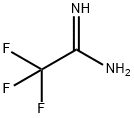
Trifluoroacetamidine (CAS 354‑37‑0) is a fluorinated amidine compound featuring a trifluoromethyl group attached to the amidine carbon. The molecule has the chemical formula CF₃C(=NH)NH₂, molecular formula C₂H₃F₃N₂ and molecular weight 112.05 g/mol. The amidine functional group can exist in various protonated or tautomeric forms depending on the medium.
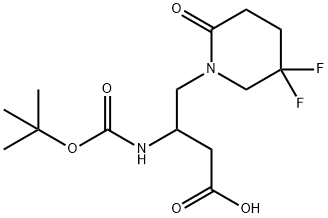
(S)-3-((tert‑Butoxycarbonyl)amino)‑4‑(5,5‑difluoro‑2‑oxopiperidin‑1‑yl)butanoic acid (CAS 911635‑43‑3) is a chiral amino acid derivative featuring a Boc‑protected amino group at the 3‑position in the S‑configuration and a difluoro‑substituted piperidinone moiety at the 4‑position.
5,6,7,8‑Tetrahydro‑2,4‑bis(trifluoromethyl)pyrido[3,4‑d]pyrimidine Hydrochloride (CAS 911636‑86‑7) is a heterocyclic compound featuring a fused pyridopyrimidine ring system with two trifluoromethyl groups at the 2‑ and 4‑positions. The molecule consists of a partially saturated pyridine ring fused to a pyrimidine ring, with the hydrochloride salt form enhancing water solubility and crystallinity, molecular formula C₉H₈ClF₆N₃ and molecular weight 307.62 g/mol.
tert‑Butyl ((1S)‑3‑{2,4‑bis(trifluoromethyl)‑5,8‑dihydropyrido[3,4‑d]pyrimidin‑7(6H)‑yl}‑1‑[(5,5‑difluoro‑2‑oxopiperidin‑1‑yl)methyl]‑3‑oxopropyl)carbamate (CAS 911637‑18‑8) is a complex, highly functionalised pharmaceutical intermediate featuring a pyridopyrimidine core with two trifluoromethyl groups, a chiral centre at the 1S position, a difluoro‑substituted piperidinone moiety, and a Boc‑protected amino group.
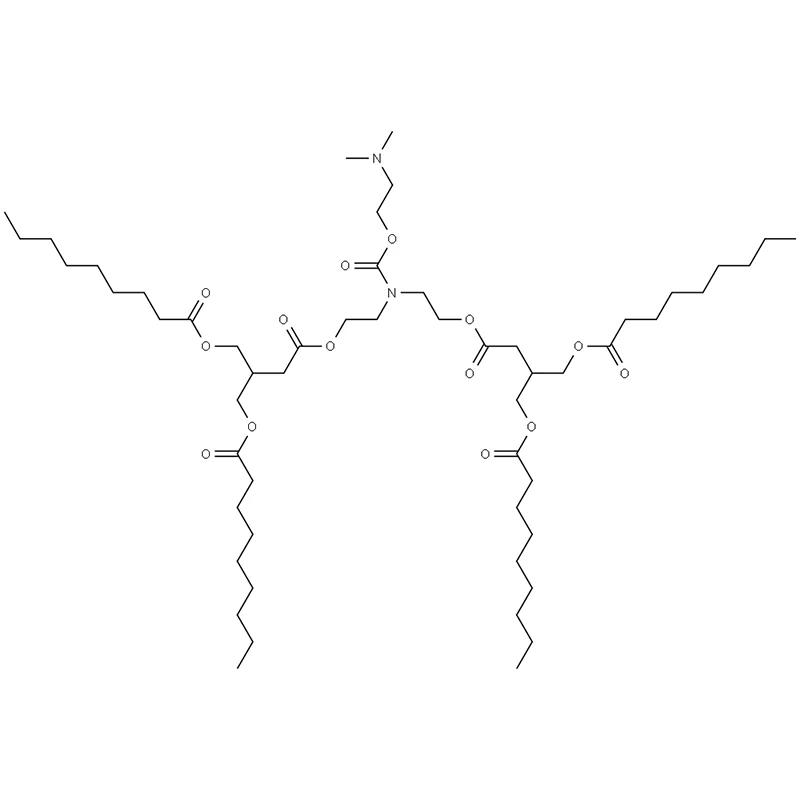
A-11 (CAS 2996998-09-3), also known as Lipid A-11 or CICL1, is an ionizable cationic lipid that serves as a building block for the synthesis of lipid‑like nanoparticles (LNPs) for nucleic acid delivery. The molecular structure of A-11 features a complex polyether‑polyamine backbone with multiple ester linkages and terminal alkoxy chains (C55H100N2O14), providing the amphiphilic character necessary for self‑assembly into lipid nanoparticles.
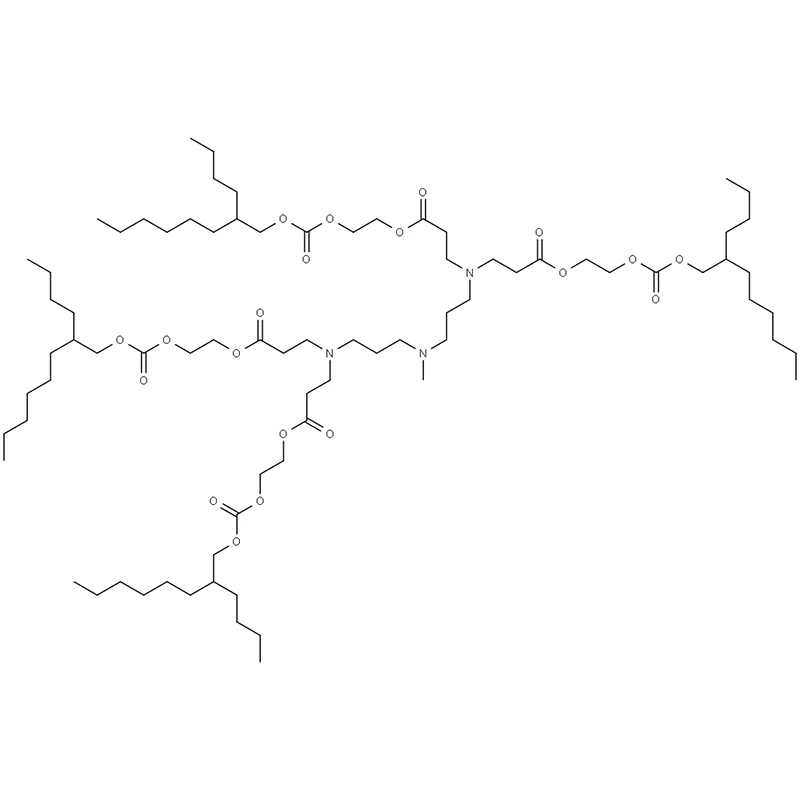
Lipid 88 is an advanced ionizable cationic lipid featuring a highly branched, multi‑arm structure designed for next‑generation mRNA delivery applications. The compound has the molecular formula C₇₉H₁₄₇N₃O₂₀, corresponding to a molecular weight of approximately 1459 g/mol. Structurally, Lipid 88 is built around a central core with multiple branching points, incorporating three tertiary amide‑linked headgroups and a network of polyethylene glycol (PEG)‑like ether linkages. The hydrophobic domain comprises multiple branched, saturated alkyl chains derived from 2‑hexyldecanoic acid. This complex architecture — featuring three protonatable amines, 20 oxygen atoms (primarily as ester and ether linkages), and an extremely high number of rotatable bonds (84) — gives Lipid 88 a highly flexible, three‑dimensional structure that facilitates efficient mRNA encapsulation and endosomal escape. The multiplicity of ionizable amines provides a broadened pH range of ionization, potentially enhancing endosomal escape efficiency across a wider range of endosomal pH values encountered in different cell types.
Cosper is a professional Intermediate manufacturer and supplier in China. We have an experienced sales team, professional technicians, and an after-sales service team.
We use cookies to offer you a better browsing experience, analyze site traffic and personalize content. By using this site, you agree to our use of cookies. Privacy Policy


![5,6,7,8-tetrahydro-2,4-bis(trifluoroMethyl)-Pyrido[3,4-d]pyriMidine hydrochloride](https://www.cosperpharma.com/upload/8820/5-6-7-8-tetrahydro-2-4-bis-trifluoromethyl-pyrido-3-4-d-pyrimidine-hydrochloride-773550.png "5,6,7,8-tetrahydro-2,4-bis(trifluoroMethyl)-Pyrido[3,4-d]pyriMidine hydrochloride")
![tert-Butyl ((1S)-3-{2,4-bis(trifluoromethyl)-5,8-dihydropyrido[3,4-d]pyrimidin-7(6H)-yl}-1-[(5,5-difluoro-2-oxopiperidin-1-yl)methyl]-3-oxopropyl)carbamate](https://www.cosperpharma.com/upload/8820/tert-butyl-1s-3-2-4-bis-trifluoromethyl-5-8-dihydropyrido-3-4-d-pyrimidin-7-6h-yl-1-5-5-difluoro-2-oxopiperidin-1-yl-methyl-3-oxopropyl-carbamate-522888.png "tert-Butyl ((1S)-3-{2,4-bis(trifluoromethyl)-5,8-dihydropyrido[3,4-d]pyrimidin-7(6H)-yl}-1-[(5,5-difluoro-2-oxopiperidin-1-yl)methyl]-3-oxopropyl)carbamate")