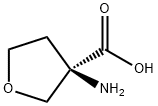
(R)-3-Aminotetrahydrofuran-3-carboxylic acid (CAS 1315053-78-1) is a chiral, non-proteinogenic, Cα-tetrasubstituted cyclic amino acid characterized by a tetrahydrofuran ring with geminal amine and carboxylic acid substituents at the 3-position. The molecule features a five-membered oxygen-containing heterocycle (tetrahydrofuran) that serves as the core scaffold, with an amino group (-NH₂) and a carboxylic acid (-COOH) both attached to the same carbon at the 3-position of the ring.
Octanoic acid, 8-[(2-hydroxyethyl)[6-oxo-6-(undecyloxy)hexyl]amino]-, 1-octylnonyl ester (SM-102) is an ionizable amino lipid featuring a central tertiary amine headgroup linked via an octanoic acid backbone to two distinct hydrophobic domains: a branched 1-octylnonyl ester tail and a long undecyloxy-terminated hexyl chain. The molecule contains a key tertiary amine moiety that remains neutrally charged at physiological pH (7.4) but becomes protonated in acidic environments (e.g., endosomal pH ~5.0–6.5), a property that enables pH-responsive charge switching. The hydroxyethyl group provides a polar handle that influences the lipid’s hydration properties and interfacial behavior during nanoparticle assembly. This structural architecture—featuring an ionizable amine, biodegradable ester linkages, and asymmetric hydrophobic tails—is the hallmark of next‑generation ionizable lipids designed for efficient mRNA encapsulation and endosomal escape. The compound is known commercially as SM-102 and serves as the key ionizable lipid component in the Moderna COVID‑19 mRNA vaccine (Spikevax®) lipid nanoparticle (LNP) formulation.
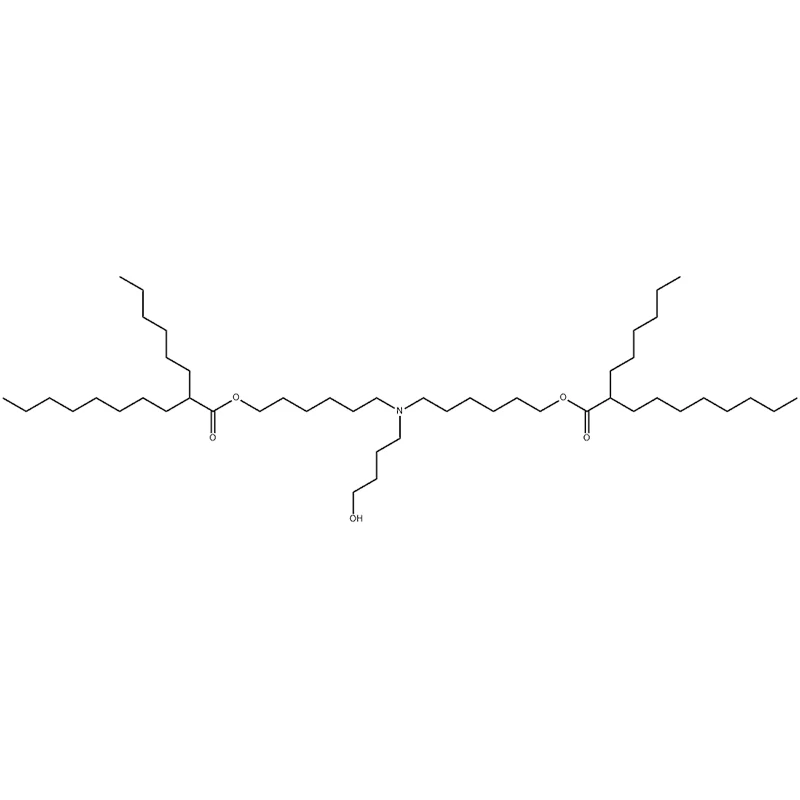
((4-hydroxybutyl)azanediyl)bis(hexane-6,1-diyl)bis(2-hexyldecanoate) (ALC-0315) is a synthetic ionizable amino lipid featuring a central tertiary amine headgroup covalently linked via two hexyl spacers to two identical branched 2‑hexyldecanoate tails. The molecule also contains a terminal hydroxybutyl group attached to the nitrogen atom, providing a polar handle that influences hydration and interfacial packing within lipid nanoparticles (LNPs). The rigid yet flexible architecture of ((4-hydroxybutyl)azanediyl)bis(hexane-6,1-diyl)bis(2-hexyldecanoate)—comprising an ionizable tertiary amine, biodegradable ester linkages, and two symmetric branched saturated alkyl tails—is specifically engineered for mRNA encapsulation, endosomal escape, and cytosolic delivery. The protonation state of the tertiary amine is pH‑sensitive: neutral at physiological pH (7.4) but positively charged in acidic endosomal environments (pH ~5.0–6.5), enabling efficient nucleic acid release. This compound is widely known as ALC‑0315 and serves as the functional ionizable lipid component in the Pfizer/BioNTech COVID‑19 mRNA vaccine (Comirnaty®).
(S)-6-(tert-Butoxycarbonyl)-6-azaspiro[3.4]octane-7-carboxylic acid (CAS 1980007-51-9) is a complex chiral spirocyclic amino acid derivative featuring a tert-butoxycarbonyl (Boc) protected nitrogen at the 6-position of a 6-azaspiro[3.4]octane scaffold, with a carboxylic acid at the 7-position. The molecule’s defining structural feature is the spirocyclic core — a bicyclic system where a cyclobutane ring (spiro[3.4]) shares a single carbon atom with a pyrrolidine ring containing a Boc-protected nitrogen.
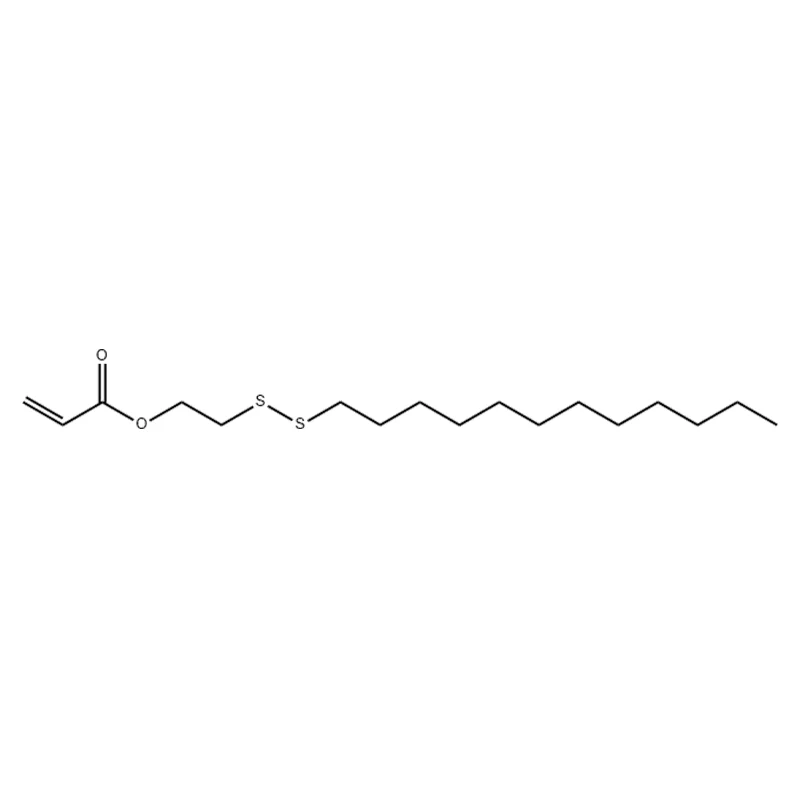
2-Propenoic Acid, 2‑(Dodecyldithio)ethyl Ester (CAS 1624618‑10‑5), also known as 2‑(dodecyldisulfanyl)ethyl acrylate or acrylic acid 2‑(dodecyldithio)ethyl ester, is a long‑chain disulfide‑containing acrylate monomer. The molecule comprises a polymerizable acrylic ester head group that readily participates in free‑radical addition polymerization, combined with a dodecyldithio segment (C₁₂H₂₅S–S–) featuring a reducible disulfide bond and a highly lipophilic dodecyl tail. Among the C₈, C₁₀, and C₁₂ homolog series, 2-Propenoic Acid, 2‑(Dodecyldithio)ethyl Ester offers the greatest hydrophobicity, enabling the formation of exceptionally stable lipid nanoparticles with extended circulation times and potentially enhanced cell membrane interaction. The disulfide bond provides redox‑responsiveness — stable under extracellular oxidizing conditions but cleaved in the reducing intracellular environment — making 2-Propenoic Acid, 2‑(Dodecyldithio)ethyl Ester an optimal building block for cationic lipids and bioreducible polymers requiring robust nanoparticle stability with triggered intracellular payload release.
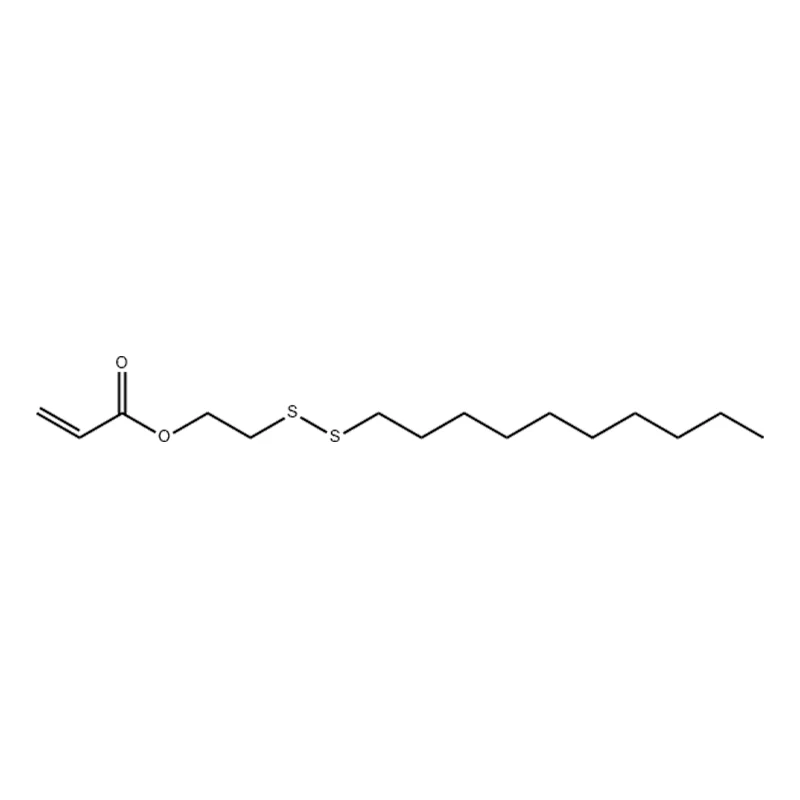
2-Propenoic Acid, 2‑(Decyldithio)ethyl Ester (CAS 1624618‑09‑2), also known as 2‑(decyldisulfanyl)ethyl acrylate or acrylic acid 2‑(decyldithio)ethyl ester, is a disulfide‑containing functional acrylate monomer. The molecule features an acrylic ester moiety that serves as a highly reactive polymerizable group via free‑radical addition polymerization, alongside a decyldithio segment (C₁₀H₂₁S–S–) that incorporates a reducible disulfide bond and a lipophilic decyl tail. This unique combination of a polymerizable acrylate head and a redox‑responsive disulfide linker positions 2-Propenoic Acid, 2‑(Decyldithio)ethyl Ester as a key building block in the synthesis of bioreducible polymers and cationic lipids for nucleic acid delivery applications. The disulfide bond confers redox‑responsiveness — stable under extracellular oxidative conditions but cleaved in the reductive intracellular environment (high glutathione concentration), enabling triggered payload release. The decyl alkyl chain provides the lipophilic character necessary for forming stable lipid nanoparticles and interacting with cell membranes.
Cosper is a professional Intermediate manufacturer and supplier in China. We have an experienced sales team, professional technicians, and an after-sales service team.
We use cookies to offer you a better browsing experience, analyze site traffic and personalize content. By using this site, you agree to our use of cookies. Privacy Policy


![Octanoic acid, 8-[(2-hydroxyethyl)[6-oxo-6-(undecyloxy)hexyl]amino]-, 1-octylnonyl ester](https://www.cosperpharma.com/upload/8820/octanoic-acid-8-2-hydroxyethyl-6-oxo-6-undecyloxy-hexyl-amino-1-octylnonyl-ester-83581.webp "Octanoic acid, 8-[(2-hydroxyethyl)[6-oxo-6-(undecyloxy)hexyl]amino]-, 1-octylnonyl ester")
![(S)-6-(tert-Butoxycarbonyl)-6-azaspiro[3.4]octane-7-carboxylicacid](https://www.cosperpharma.com/upload/8820/-s-6-tert-butoxycarbonyl-6-azaspiro-3-4-octane-7-carboxylicacid-885326.png "(S)-6-(tert-Butoxycarbonyl)-6-azaspiro[3.4]octane-7-carboxylicacid")