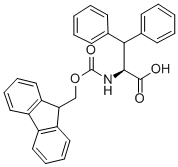
Fmoc-3,3-Diphenylalanine is a sterically hindered Fmoc-protected unnatural amino acid featuring two phenyl rings attached to the β-carbon of the alanine backbone. Structurally, the molecule comprises a fluorenylmethyloxycarbonyl (Fmoc) group protecting the α-amino functionality, a central chiral alanine-derived framework, and a geminal diphenyl substitution at the 3-position (Cβ). This unique 3,3-diphenyl substitution creates a highly congested structural motif with significant steric bulk around the side chain, imposing conformational constraints on the backbone when incorporated into peptides.
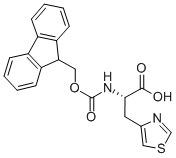
Fmoc-3-(4-thiazolyl)alanine (Fmoc-Tza-OH) is an Fmoc-protected unnatural amino acid featuring a 4-thiazolyl side chain attached to the alanine backbone. The molecule consists of a fluorenylmethyloxycarbonyl (Fmoc) group protecting the α-amino functionality, a central alanine-derived chiral center, and a thiazole heterocycle at the β-position. The thiazole ring introduces both aromatic character and a lone pair-bearing nitrogen atom, imparting unique electronic properties and metal-coordination capabilities that are highly valued in medicinal chemistry and peptide engineering.
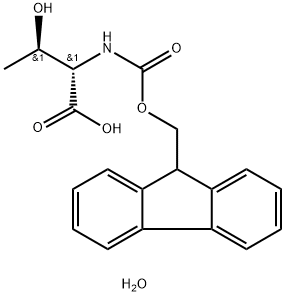
Fmoc-Thr-OH·H₂O (N-α-fluorenylmethyloxycarbonyl-L-threonine monohydrate) is the Fmoc-protected derivative of the naturally occurring amino acid L-threonine, featuring a water molecule of crystallization in the crystalline lattice. The Fmoc (9-fluorenylmethoxycarbonyl) protecting group is attached to the α-amino group of threonine via a carbamate linkage, while the side chain hydroxyl group remains free. The presence of the monohydrate form enhances the crystallinity and long‑term storage stability of the product compared to the anhydrous form.
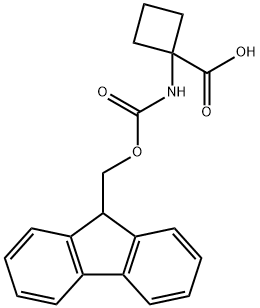
Fmoc-1-Aminocyclobutane-1-Carboxylic Acid (Fmoc-Ac4c-OH) is a conformationally constrained non-natural amino acid derivative featuring a cyclobutane ring at the α‑carbon position, with the amino group protected by the 9‑fluorenylmethoxycarbonyl (Fmoc) group. The four‑membered cyclobutane ring imposes significant ring strain (approximately 26 kcal/mol) and restricts the conformational flexibility of the amino acid backbone, locking the molecule into a well‑defined three‑dimensional geometry. This rigid, cyclic aliphatic framework effectively pre‑organizes the α‑carboxylate and the protected amino group, reducing the entropic penalty upon incorporation into peptide chains.
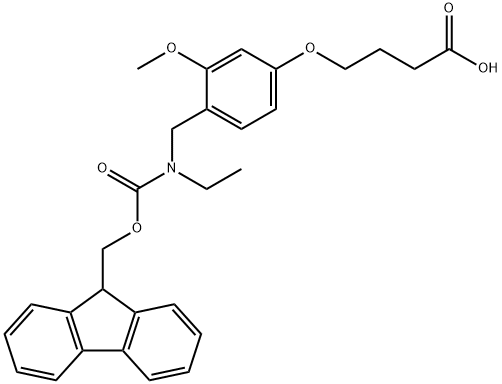
Fmoc-N-ethyl-MPBA (4-(4-(N-Fmoc-N-ethyl)aminomethyl-3-methoxy-phenoxy)butyric acid) is a specialized Fmoc-protected aminoethylphenoxybutyric acid derivative that combines a rigid aromatic scaffold with a flexible butyric acid side‑chain and an N‑ethylated benzylamine functionality protected by the 9-fluorenylmethoxycarbonyl (Fmoc) group. Structurally, the molecule consists of a central 3‑methoxyphenyl ring bearing a para‑linked butyric acid chain via an ether oxygen, while the N‑ethylaminomethyl substituent at the 4‑position is protected by the base‑labile Fmoc group. This unique architecture pre‑organizes a carboxylic acid handle (for conjugation or solid‑phase attachment) and a secondary amine (protected by Fmoc for orthogonal deprotection) within a rigid aromatic framework.
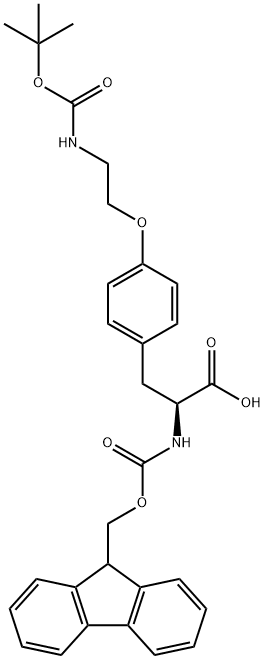
The product is Fmoc-Tyr(Boc-2-aminoethyl)-OH (O-[2-[(tert-butoxycarbonyl)amino]ethyl]-N-[(9H-fluoren-9-ylmethoxy)carbonyl]-L-tyrosine), a highly specialized Fmoc-protected tyrosine derivative featuring dual orthogonal protecting groups on its side chain. Structurally, the molecule comprises the amino acid tyrosine as its core, with the N-terminus protected by the base-labile 9-fluorenylmethyloxycarbonyl (Fmoc) group suitable for solid-phase peptide synthesis (SPPS). The phenolic hydroxyl group of the tyrosine side chain is modified by a Boc-protected 2-aminoethyl ether linkage (−O−(CH₂)₂−NH−Boc), installing a second orthogonal protecting group (Boc, tert-butoxycarbonyl) that is cleaved under acidic conditions. This dual orthogonal protection architecture — Fmoc (base‑labile) at the N‑terminus and Boc (acid‑labile) on the side chain — enables selective deprotection of one functionality while leaving the other intact during multi‑step peptide assembly and conjugation strategies.
We use cookies to offer you a better browsing experience, analyze site traffic and personalize content. By using this site, you agree to our use of cookies. Privacy Policy