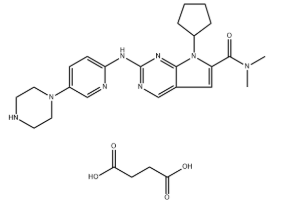

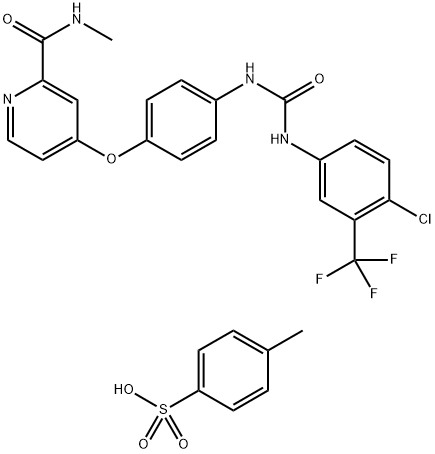
Sorafenib Tosylate (BAY 43-9006 tosylate) is an orally active multikinase inhibitor approved for the treatment of advanced renal cancer, hepatocellular carcinoma, and thyroid cancer. Sorafenib Tosylate works by inhibiting the VEGFR-2/PDGFR-β signaling cascade, thereby blocking tumor angiogenesis. Sorafenib Tosylate also targets Raf-1 and B-RAF (IC₅₀ = 6 and 22 µM, respectively), as well as receptor tyrosine kinases VEGFR2. As an API, Sorafenib Tosylate is manufactured under strict quality controls to ensure consistent therapeutic efficacy. In pharmaceutical quality control, Sorafenib Tosylate reference standards are essential for analytical method development and impurity profiling. The tosylate salt form of Sorafenib Tosylate provides the active pharmaceutical ingredient in the marketed formulation.
Product Parameters
|
Parameter |
Specification |
|
Product Name |
Sorafenib Tosylate |
|
CAS Number |
475207-59-1 |
|
Molecular Formula |
C₂₈H₂₄ClF₃N₄O₆S |
|
Molecular Weight |
637.03 g/mol |
|
Melting Point |
229–232 °C |
|
Physical Form |
Solid |
|
Storage Condition |
2–8 °C (protect from light) |
Effect
Pharmacological Action
Treatment of advanced liver cancer
Researchers from multiple countries published a report in the latest issue of the New England Journal of Medicine, reporting that they conducted a study involving 602 patients with advanced hepatocellular carcinoma across countries and regions including the United States, Europe, and Australia.
None of these patients had received systematic treatment prior to the study. The results demonstrated that compared with placebo, administration of sorafenib toluenesulfonate (Sorafenib) prolonged overall survival by approximately 44% and delayed disease progression by 73% in patients with advanced or primary hepatocellular carcinoma.
One of the principal investigators of this study, Jordi Brux from Barcelona Clinical Hospital in Spain, stated that global liver cancer mortality continues to rise due to the prevalence of hepatitis B and C. The new research findings demonstrate that Sorafenib Tosylate, as a novel therapeutic option for liver cancer, can effectively prolong patient survival, a result described as "encouraging."
Sorafenib Tosylate (Tislelizumab) is manufactured by Bayer Healthcare AG in Germany and exerts dual effects on both tumor cells and tumor vasculature. Researchers presented findings at the American Society of Clinical Oncology annual meeting in June last year, demonstrating that a study conducted among patients with advanced hepatocellular carcinoma in the Asia-Pacific region showed Sorafenib could prolong survival by approximately 47%. It remains the only drug proven to significantly extend overall survival in patients with advanced hepatocellular carcinoma.
This drug was approved in the United States and Europe respectively last year for the treatment of liver cancer. In August 2009, Bayer Healthcare issued a press release stating that Torotredimab had received approval from the China National Medical Products Administration for the treatment of patients with advanced liver cancer who are not candidates for surgery.
Contact Us
Address
No. 2 Yangguang 3rd Road, Duodao Chemical Cycle Industrial Park, Jingmen City, Hubei Province, China
Tel