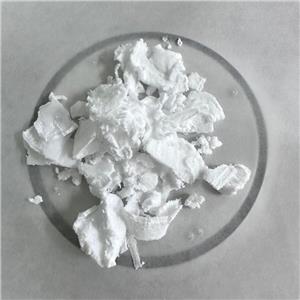
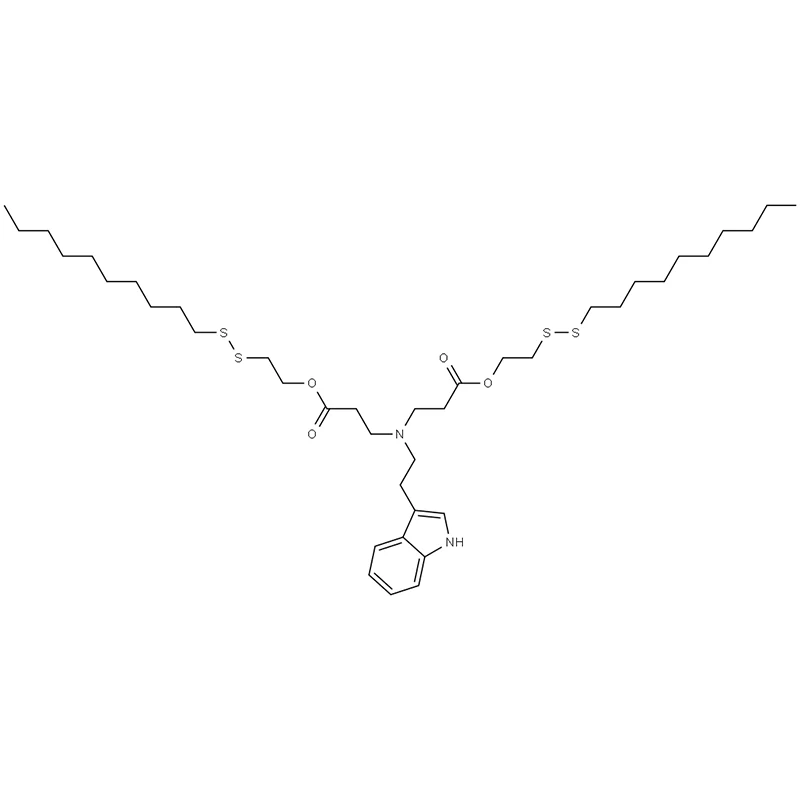
The product is Bis(2-(decyldisulfaneyl)ethyl) 3,3'-((2-(1H-indol-3-yl)ethyl)azanediyl)dipropionate, a bioreducible ionizable lipid constructed around a tryptophan-derived indole-ethylamine headgroup that is di-N-alkylated with propionate esters bearing terminal decyldisulfanyl-ethyl arms. The disulfide motifs act as redox-sensitive triggers, remaining stable in the oxidizing extracellular environment but undergoing rapid cleavage when exposed to the elevated intracellular concentrations of glutathione, thereby converting the initially hydrophobic lipid into small, membrane-inert fragments. This built-in biodegradation switch, combined with the membrane-anchoring properties of the indole ring, positions Bis(2-(decyldisulfaneyl)ethyl) 3,3'-((2-(1H-indol-3-yl)ethyl)azanediyl)dipropionate as a compelling candidate for tumor-selective gene delivery and other applications where release must be precisely confined to the intracellular reducing milieu.
The product is 113-O16B, a rationally designed ionizable lipid whose architecture integrates a tertiary amine protonation center, two ester-linked lipophilic domains that can be hydrolyzed by intracellular esterases, and a short hydroxyl-terminated spacer that fine-tunes the apparent acid dissociation constant of the nanoparticle surface. This structural triad allows 113-O16B to remain largely neutral in circulation, condense polyanionic messenger RNA into compact nanoparticles under acidic formulation conditions, and subsequently trigger endosomal membrane disruption through a lamellar-to-inverted hexagonal phase transition, establishing it as a high-performance lipid for liver-directed mRNA therapeutics.
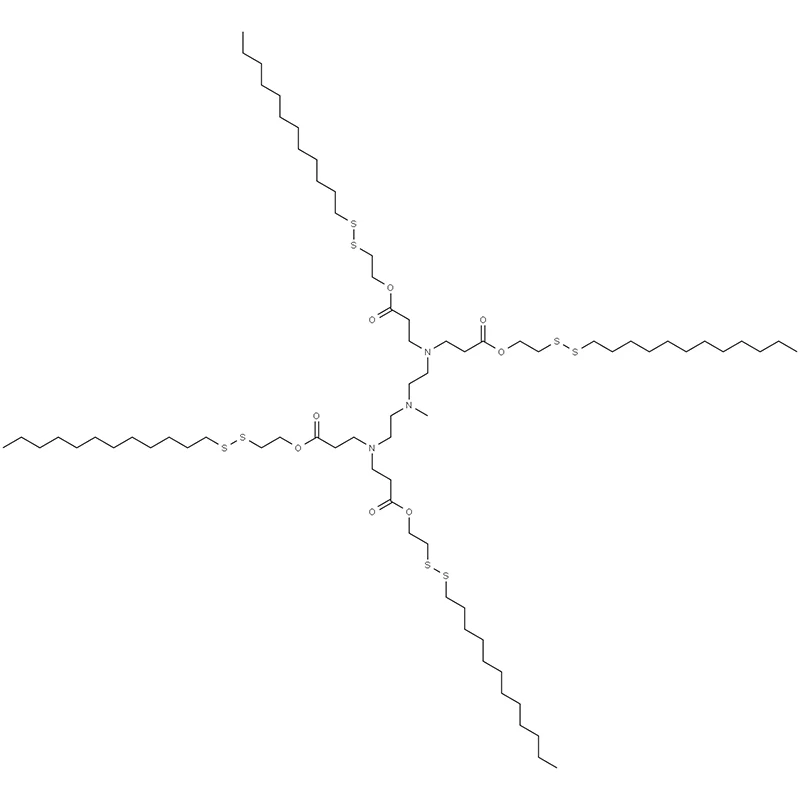
The product is 16-Oxa-19,20-dithia-4,8,12-triazaoctacosanoic acid, 8-methyl-4,12-bis[3-[2-(octyldithio)ethoxy]-3-oxopropyl]-15-oxo-, 2-(octyldithio)ethyl ester, a multi-arm bioreducible ionizable lipid constructed around a linear triamino backbone that is decorated with three identical octyldithioethyl-esterified propionate arms and a central N-methyl group. The molecule’s three symmetrically placed disulfide bonds serve as independent redox cleavage sites, while the 8-methyl substitution modulates the tertiary amine pKa and steric environment. This extended, branched architecture allows the lipid to form exceptionally stable lipid nanoparticles with high nucleic acid loading capacity, making 16-Oxa-19,20-dithia-4,8,12-triazaoctacosanoic acid, 8-methyl-4,12-bis[3-[2-(octyldithio)ethoxy]-3-oxopropyl]-15-oxo-, 2-(octyldithio)ethyl ester a powerful tool for multivalent delivery applications where controlled, glutathione-triggered disassembly is paramount.
The product is 3-[3-imidazol-1-ylpropyl-[3-oxo-3-(2-tetradecanoxyethoxy)propyl]amino]propanoic acid 2-tetradecanoxyethyl ester, a heterocycle-functionalized ionizable lipid built around an imidazole-propylamine core that is symmetrically extended through two 3-oxopropanoate ester linkages to tetradecanoxyethoxy tails. The imidazole ring introduces an additional protonatable site beyond the tertiary amine, allowing the molecule to modulate its charge state over a broader pH range, while the two 14-carbon saturated tails provide enhanced bilayer stability and controlled phase behavior. This specific structural combination makes 3-[3-imidazol-1-ylpropyl-[3-oxo-3-(2-tetradecanoxyethoxy)propyl]amino]propanoic acid 2-tetradecanoxyethyl ester particularly useful for lipid nanoparticle formulations that require fine-tuned endosomal release kinetics and extended shelf stability.
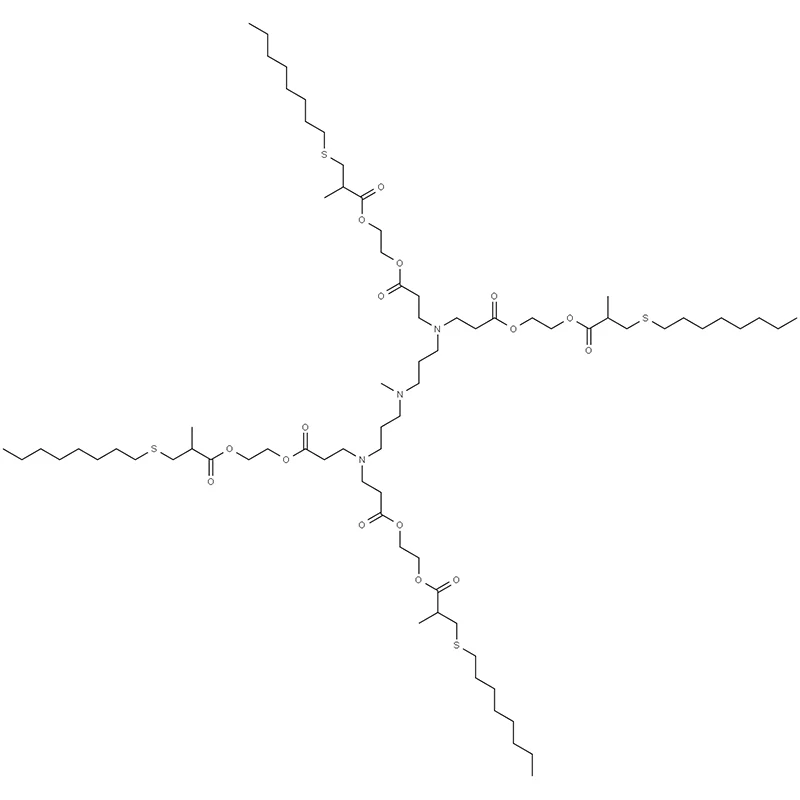
4A3-SC8 is a modular, ionizable cationic lipid (pKa ≈ 6.66) that functions as a degradable dendrimer. Structurally, it features a dendritic architecture with a central tertiary amine that is pH-responsive, protonated at endosomal pH to facilitate membrane disruption, while remaining neutral in the bloodstream to enhance circulation. The inclusion of hydrolytically degradable ester linkages in its structure and thioether bonds in its tails renders it biodegradable, improving its safety profile for in vivo use. This combination of structural features makes it a highly versatile and robust ionizable lipid for the formulation of LNPs.
The product is β-Alanine, N-[3-(dimethylamino)propyl]-N-[3-[2-(dodecyldithio)ethoxy]-3-oxopropyl]-, 2-(dodecyldithio)ethyl ester, a glutathione-sensitive ionizable lipid built on a β-alanine scaffold that carries three functionally distinct domains: a pendant N,N-dimethylaminopropyl group that provides the primary protonation site, a 2-(dodecyldithio)ethyl ester moiety that anchors one reducible C12 tail through the carboxyl terminus, and an N-linked 3-[2-(dodecyldithio)ethoxy]-3-oxopropyl arm that introduces a second dodecyldisulfanyl chain. This dual-disulfide design ensures that the intact lipid remains stably integrated within the lipid nanoparticle during extracellular transit but undergoes rapid fragmentation into three small, water-soluble fragments upon exposure to the millimolar glutathione concentrations of the cytosol, thereby achieving cargo release that is chemically gated by intracellular redox potential.
Cosper is a professional Intermediate manufacturer and supplier in China. We have an experienced sales team, professional technicians, and an after-sales service team.
We use cookies to offer you a better browsing experience, analyze site traffic and personalize content. By using this site, you agree to our use of cookies. Privacy Policy


![16-Oxa-19,20-dithia-4,8,12-triazaoctacosanoic acid, 8-methyl-4,12-bis[3-[2-(octyldithio)ethoxy]-3-oxopropyl]-15-oxo-, 2-(octyldithio)ethyl ester](https://www.cosperpharma.com/upload/8820/16-oxa-19-20-dithia-4-8-12-triazaoctacosanoic-acid-8-methyl-4-12-bis-3-2-octyldithio-ethoxy-3-oxopropyl-15-oxo-2-octyldithio-ethyl-ester-41980.webp "16-Oxa-19,20-dithia-4,8,12-triazaoctacosanoic acid, 8-methyl-4,12-bis[3-[2-(octyldithio)ethoxy]-3-oxopropyl]-15-oxo-, 2-(octyldithio)ethyl ester")
![3-[3-imidazol-1-ylpropyl-[3-oxo-3-(2-tetradecanoxyethoxy)propyl]amino]propanoic acid 2-tetradecanoxyethyl ester](https://www.cosperpharma.com/upload/8820/3-3-imidazol-1-ylpropyl-3-oxo-3-2-tetradecanoxyethoxy-propyl-amino-propanoic-acid-2-tetradecanoxyethyl-ester-972329.webp "3-[3-imidazol-1-ylpropyl-[3-oxo-3-(2-tetradecanoxyethoxy)propyl]amino]propanoic acid 2-tetradecanoxyethyl ester")
![β-Alanine, N-[3-(dimethylamino)propyl]-N-[3-[2-(dodecyldithio)ethoxy]-3-oxopropyl]-, 2-(dodecyldithio)ethyl ester](https://www.cosperpharma.com/upload/8820/-alanine-n-3-dimethylamino-propyl-n-3-2-dodecyldithio-ethoxy-3-oxopropyl-2-dodecyldithio-ethyl-ester-855732.webp "β-Alanine, N-[3-(dimethylamino)propyl]-N-[3-[2-(dodecyldithio)ethoxy]-3-oxopropyl]-, 2-(dodecyldithio)ethyl ester")