Fmoc-Lys(Mmt)-OH (Nα-Fmoc-Nε-4-methoxytrityl-L-lysine) is an orthogonally protected lysine derivative featuring a highly acid‑labile 4‑methoxytrityl (Mmt) protecting group on the ε‑amino side chain. The molecule consists of a base‑labile Fmoc group installed at the α‑amino terminus, a bulky and highly electron‑rich methoxytrityl group protecting the ε‑amine of the lysine side chain, and a free α‑carboxylate for coupling. The Mmt group is significantly more acid‑labile than traditional protecting groups such as Boc or Trt, and can be selectively removed under extremely mild acidic conditions (1% TFA in DCM) that leave all other standard acid‑labile protecting groups intact. This extraordinary acid sensitivity makes Fmoc-Lys(Mmt)-OH an excellent building block for the synthesis of branched peptides, cyclic peptides, and complex multifunctionalized peptide conjugates via Fmoc solid‑phase peptide synthesis.
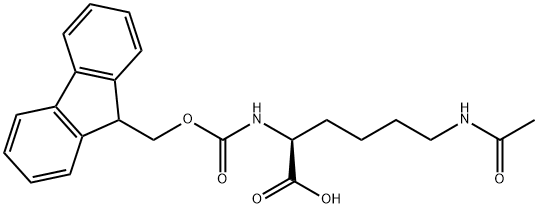
Fmoc-Lys(Ac)-OH (N-α-fluorenylmethyloxycarbonyl-N-ε-acetyl-L-lysine) is a uniquely modified lysine derivative in which the ε-amino group of the lysine side chain is protected by an acetyl (Ac) group. The Fmoc group on the α-amino function is removed under standard basic conditions (20% piperidine in DMF) during peptide chain assembly, while the ε-acetyl group remains stable throughout the entire Fmoc SPPS process and the final TFA-mediated global deprotection. This modification allows for the direct introduction of N-ε-acetyl-lysine residues into synthetic peptides, which is particularly valuable for studying acetylation-dependent protein-protein interactions, enzyme-substrate recognition, and epigenetic signaling pathways where lysine acetylation plays a critical regulatory role.
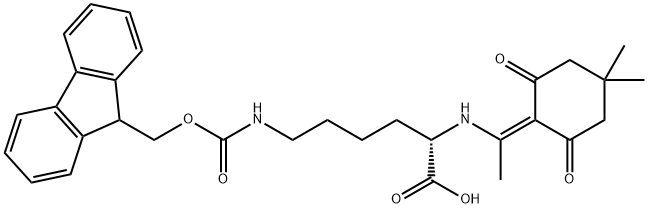
Dde-Lys(Fmoc)-OH (N-α-1-(4,4-dimethyl-2,6-dioxocyclohex-1-ylidene)ethyl-N-ε-fluorenylmethoxycarbonyl-L-lysine) is an orthogonally protected lysine derivative that incorporates two distinct protecting groups on the α-amino and ε-amino functions. The Fmoc (9-fluorenylmethyloxycarbonyl) group is attached to the α-amino group and is selectively removed under mild basic conditions, typically 20% piperidine in DMF. The Dde (1-(4,4-dimethyl-2,6-dioxocyclohex-1-ylidene)ethyl) group protects the ε-amino side chain and is orthogonal to both Fmoc and Boc chemistries, requiring treatment with 2% hydrazine in DMF for selective cleavage. This orthogonal protection strategy enables the sequential assembly of complex peptide architectures, making Dde-Lys(Fmoc)-OH an essential building block for constructing branched peptides, cyclic peptides, multiple antigenic peptides (MAPs), and site-specifically modified peptides in Fmoc solid-phase peptide synthesis (Fmoc SPPS) workflows.
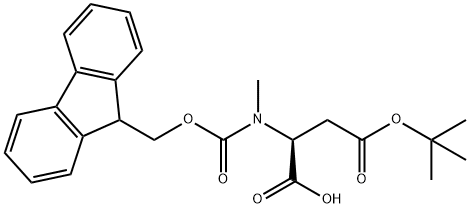
Fmoc-N-Me-Asp(OtBu)-OH (Nα-Fmoc-Nα-methyl-L-aspartic acid β-tert-butyl ester) is a specialized N‑methylated aspartic acid derivative designed for incorporation into peptides via Fmoc solid‑phase peptide synthesis (Fmoc SPPS). The molecule features three key structural components: a base‑labile Fmoc group protecting the α‑amino terminus, an N‑methylation at the α‑amino position (imparting the N‑methyl amino acid character), and a tert‑butyl ester (OtBu) protecting the β‑carboxylic acid side chain. The N‑methylation rigidifies the peptide backbone, reducing conformational flexibility and conferring enhanced proteolytic stability to peptide sequences — a property that is increasingly exploited in the design of metabolically stable therapeutic peptides and peptidomimetics.
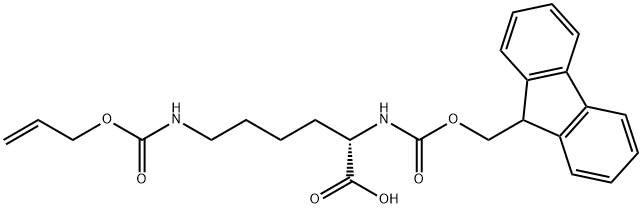
Fmoc-Lys(Alloc)-OH (Nα-Fmoc-Nε-allyloxycarbonyl-L-lysine) is an orthogonally protected lysine derivative designed specifically for Fmoc solid-phase peptide synthesis (Fmoc SPPS). The molecule features two orthogonal protecting groups: a base-labile Fmoc (9-fluorenylmethoxycarbonyl) group installed on the α-amino terminus, and an orthogonal allyloxycarbonyl (Alloc) group protecting the ε-amino side chain. This dual-protection strategy creates a versatile building block in which the Fmoc group can be removed under standard piperidine conditions during chain elongation, while the Alloc group remains intact, allowing for selective side‑chain deprotection and modification at a later stage.
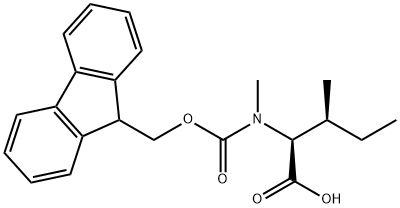
Fmoc-N-Me-Ile-OH (N‑α‑Fmoc‑N‑α‑methyl‑L‑isoleucine) is a non‑natural, N‑methylated amino acid derivative specifically designed for Fmoc‑based solid‑phase peptide synthesis (SPPS). Structurally, the molecule consists of an isoleucine backbone where the α‑amino group bears an N‑methyl substituent, and the secondary amine is protected by the base‑labile 9‑fluorenylmethyloxycarbonyl (Fmoc) group. The C‑terminal carboxylic acid remains free for coupling. The presence of the N‑methyl group introduces conformational constraint into the peptide backbone, as N‑methylated amides adopt distinct cis/trans preferences compared to unsubstituted amides. This constrained architecture enhances the metabolic stability of peptides by rendering the amide bond resistant to proteolytic cleavage, while also improving membrane permeability and oral bioavailability in both in vitro and in vivo pharmacological studies. The Fmoc group, which is cleaved under mild basic conditions (20% piperidine in DMF), is orthogonal to acid‑labile side‑chain protecting groups, ensuring compatibility with standard Fmoc SPPS protocols. Fmoc-N-Me-Ile-OH is a building block for the introduction of N‑α‑methyl‑isoleucine amino acid residues into synthetic peptides using Fmoc SPPS.
We use cookies to offer you a better browsing experience, analyze site traffic and personalize content. By using this site, you agree to our use of cookies. Privacy Policy